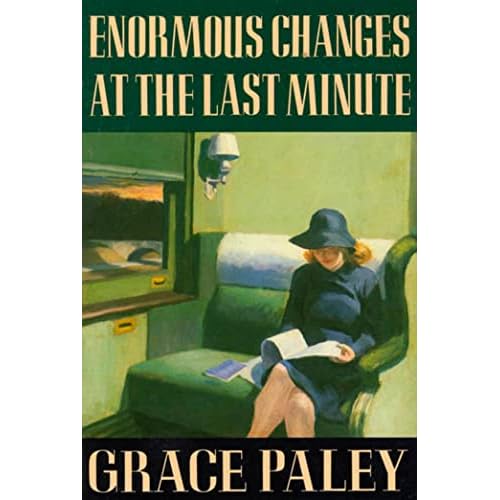
Grace Paley is one of my heroes as a writer. Enormous Changes at the Last Minute, especially "A Conversation with My Father," is essential reading for me. I read this book straight through every year (the way many people read the Bible), and always I'm taking away the voices--so much of her work is a conversation with the reader, a folk tale she's spinning about faith and Faith.
Another definition of conversation, a biblical one, is lifestyle, and as much as I admire the work I admire the life. It's a life, not only a "literary life," but one filled to the brim with politics and writing and family and friendships. Her conversation really is how to live a life.
Among the quotes of Paley's I love and have saved in my journals are these.
"There isn't a story written that isn't about blood and money. People and their relationship to each other is the blood, the family. And how they live, the money of it."
________________________________________________________
"We write about what we don't know about what we know."
________________________________________________________
"The act of illumination is a political act. That is, the act of saying, "See, this has been in darkness. This life has been unseen, and unknown." Now, to make that decision and say, "I want to illuminate this life"—which is the act of bringing justice into the world a little bit—that's a decision you make. But if you say, "Here's a life that's lying there. Now I'd like to take a rock and slowly cover it," that's a political' decision. I think people do that with language all the time. Sentimental language does that."
_________________________________________________________
"Somehow or other in fiction I was able to really hear with this other ear—to use both. I mean the kind of traditional educated literary knowledge of this ear and then the ear that really had been just listening to people all the time, and used the language of place and time.
"When you write poetry—this is a false definition, but you'll see what I mean when I say it—when people write poetry it's really talking to the world....That's one definition: poetry is addressing the world and fiction is getting the world to talk to you. When I was able to get into somebody else's voice, when I was able to speak in other people's voices, I found my own. Until then I did not have a voice that could tell a story."
__________________________________________________________
(On being asked why there have been no great women writers before the 20th century)
"What do you mean? What's great? Great goes up and goes down. Shakespeare wasn't great for a period there. Then he got great, then he got greater, then he got greatless, then he got greater again. I think the main thing is that women have been bringing up children. They haven't had work of their own of any kind—I mean why should they, if they weren't great anythings, why would they be great writers? I mean they weren't great mercantilists either. They weren't great capitalists murdering the world. They were not in public life. And writing is an extremely public art. I just look at it from the other side. I say how amazing that Jane Austen wrote and was appreciated. There were plenty of women writing, different kinds of women, you know. George Eliot. How come they did it? How come Mrs. Gaskell really did it? How come Charlotte Perkins Gilman did it? How brave George Sand was! How come Kate Chopin did it? That's the way I look at it, in an entirely different way. The miracle is what women have done in this world. It's miraculous that they did the work they did on such a high level. Where did they do it? And wearing the clothes they were wearing? How could they even sit to do it? I mean they must have loosened something. But if they were in the family parlor, they couldn't loosen everything."
Only Grace Paley could bring stays and staying power together!
P.S. The last three quotes are from an interview with Paley in Women Writers Talking(link above), which is available through Barnes and Noble (link), Amazon, and also through Questia's online library.

