Wednesday, December 30, 2009

Frankenstein , or The Modern Prometheus


TODAY IN HISTORY: December 30, 1816

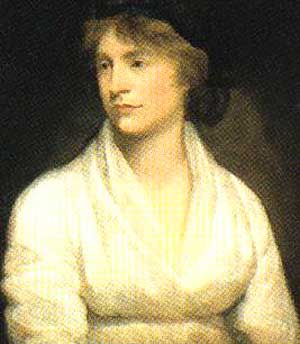
Percy Bysshe Shelley and Mary Wollstonecraft Godwin wed

On this day, Percy Bysshe Shelley and Mary Wollstonecraft Godwin wed. The pair had run away together in July 1814, but because Shelley was already married they were unable to marry for two years, until the death of Shelley's wife.

Shelley, the heir to his wealthy grandfather's estate, was expelled from Oxford when he refused to acknowledge authorship of a controversial essay. He eloped with his first wife, Harriet Westbrook, the daughter of a tavern owner, in 1811. However, just a few years later Shelley fell in love with the young Mary Wollstonecraft Godwin, daughter of a prominent reformer and an early feminist writer. Shelley and Godwin fled to Europe and married in 1816.

Shelley's inheritance did not pay all the bills, and the couple spent much of their married life abroad, fleeing Shelley's creditors. While living in Geneva, the Shelleys and their dear friend Lord Byron challenged each other to write a compelling ghost story. Only Mary Shelley finished hers and later published the story as Frankenstein.

The Shelleys had five children, but only one lived to adulthood. After Shelley drowned in a sailing accident when Mary was only 24, she edited two volumes of his works. She lived on a small stipend from her father-in-law, Lord Shelley, until her surviving son inherited his fortune and title in 1844. She died at the age of 53. Although she was a respected writer for many years, only Frankenstein and her journals are still widely read.

)))))))))))))))))))))))
For more on Mary and Percy, please check out this link:

http://www.carondelet.pvt.k12.ca.us/frankenstein/MaryShelley/Second%20Page%20%28mary%20Shelly%29.htm


Widget_logo

Wednesday, December 23, 2009

"Love Calls Us to the Things of This World": Diane Savino


“Turn on the television. We have a wedding channel on cable TV devoted to the behavior of people on the way to the altar. They spend billions of dollars, behave in the most appalling way, all in an effort to be princess for a day. You don’t have cable television? Put on network TV. We’re giving away husbands on a game show. You can watch The Bachelor, where thirty desperate women will compete to marry a 40-year-old man who has never been able to maintain a decent relationship in his life.”

“That’s what we’ve done to marriage in America, where young women are socialized from the time they’re five years old to think of being nothing but a bride. They plan every day what they’ll wear, how they’ll look, the invitations, the whole bit, they don’t spend five minutes thinking about what it means to be a wife. People stand up there before god and man even in Senator Diaz’s church, they swear to love honor and obey, they don’t mean a word of it. So if there’s anything wrong with the sanctity of marriage in America, it comes from those of us who have the privilege and the right and have abused it for decades.”

Wednesday, December 16, 2009

Circling Something: Matisse and Simon

Matisse, The Banquet


Simon and Garfunkel sing a "Cyrcle" song that's actually a S/G song.

Happy B-Day


Unrequited love is a central theme of Peanuts: while Sally worships Linus, Peppermint Patty and Marcie adore Charlie Brown, Charlie Brown pines for the Little Red-Haired Girl, and Lucy LOVES Schroeder - in no case is the feeling reciprocated.

Schulz once remarked, "I don't know why there's so much unrequited love in my strip. I seem to be fascinated by unrequited love, if not obsessed by it... There's something funny about unrequited love - I suppose it's because we can all identify with it. We've all been turned down by someone we love, and it's probably the most bitter blow in life."

Unrequited love also plagued Beethoven's life. Though it was reported that he made many conquests of the heart as a young man, his love objects were frequently women who were unavailable because they were of noble birth and he was not. Noble women who married someone of a lower class lost both their nobility and rights to income from their estates. In 1804 Beethoven fell in love with a beautiful widow named Josephine von Brunswick, an accomplished pianist. Though she loved him in return, she had to renounce Beethoven because of her four children, who would have also lost their nobility and inheritances if she had followed her heart. Before she turned him down, he confided in a powerful love letter: "My heart will only - cease - to beat for you - when - it no longer beats -"

His most famous love letter was written on July 6-7, 1812, to a woman he only named as his "Immortal Beloved" in the middle of the letter. The identity of the woman remains hotly contested even today, but, in keeping with his pattern, all three leading candidates were married women in 1812. The ten-page letter is full both of passion and ambivalence: "Can our love exist but by sacrifices, by not demanding everything... I can only live either wholly with you or not at all, yes, I have resolved to stray about in the distance, until I can fly into your arms and can call myself entirely at home with you... never can another own my heart, never- never -... at my age I would need conformity regularity of life - can this exist in our relationship?" The letter closes with passion: "today -yesterday - What tearful longing for you - you - you - my life - my all - farewell - o continue to love me-"

(This is from the amazing website of the American Beethoven Society (link above), whose recordings and exhibits are first rate. Listen to some Beethoven today, or play it beautifully, or haltingly as I did, 35 years after my last piano recital, when I played Adagio Cantabile,, also known as Pathetique. I'm no musician, but I'm thankful every day for those lessons.

I'm also thankful today for reciprocated love. Who else had coffee and pale blue iris in bed for Beethoven's birthday? Harvey is amazing).

Monday, December 14, 2009

Rainy Days and Mondays and Bad Hair


"It's only hair. It will grow out." I think I read that in Ann Landers.

Whoever wrote "Monday's Child is fair of face" hasn't seen my face this Monday: Crestfallen with cowlicks. (Are cowlicks the italics of hair?)

Monday, December 07, 2009

Happy Birthday, Willa Cather! (from Today in History)

December 7, 1873
Willa Cather is born


On this day in 1873, Willa Cather is born in Winchester, Virginia. Cather was the first of seven children born to an old Virginia family dating back to colonial times. Her maternal grandfather served several terms in the Virginia House of Delegates. Her grandmother was a strong, courageous woman who had a powerful influence on Cather and served as the model for several of her characters.

Cather's family moved to Red Cloud, Nebraska, when she was a child, and for the rest of her life she wrote about the deep conflict she felt between East and West. While books like O Pioneers (1913) and My Antonia (1918) celebrated the spirit of the frontier, in other works, such as The Song of the Lark (1915), she explores the stifling effects of small-town life on creative young minds.

After graduating from the University of Nebraska in Lincoln in 1895, Cather moved to Pittsburgh to be an editor for a family magazine. She later became an editor for the daily paper in Pittsburgh. In 1901, she became a teacher and stuck with it for several years while she published her first book of verse, April Twilights (1903), and her first collection of stories, The Troll Garden (1905). She moved to New York to take a job as managing editor of McClure's, a monthly publication, and began writing novels. Her first, Alexander's Bridge, appeared in 1912, but she didn't find her true voice until O Pioneers. Cather won a Pulitzer in 1922 for One of Ours. Her 1927 novel, Death Comes for the Archbishop, the story of two French-Canadian priests who build a cathedral in the wilds of New Mexico, was also well received. Cather lived most of her adult life in New York, writing novels until she died in 1947.


I like this photograph of Cather because the geometry of her dress parallels the geometry of her bookshelves. (It's very Mission, just like the slats of the desk at which I sit and two of the bookcases in my study!)

Here's another fascinating tidbit about Cather. Back when she plaited her plaits along the Platte, she signed her name as William Cather, M.D. and listed her favorite job duty as "amputating limbs." For a look at her autograph, check out this link:


http://www.willacather.org/cather-blog/455-coming-soon-wm-cather-md-and-the-mental-portrait-album


Widget_logo

Wednesday, December 02, 2009

Marilyn Monroe, Home Video


My Lord, she was beautiful. That profile shot could crack your heart clean as a walnut.
_____________________

Rob Brezny's Astrology: Horoscope for Cancer

CANCER (June 21-July 22): Lately you remind me of the person Robert Hass describes in his poem "Time and Materials": "someone falling down and getting up and running and falling and getting up." I'm sending you my compassion for the times you fall down, and my admiration for the times you get up, and my excitement for the times you run. It has probably become clear to you by now that the falling down isn't a shameful thing to be cursed, but rather is an instrumental part of the learning process that is teaching you marvelous secrets about getting back up and running.

I find this post particularly intriguing, as this has been my life after stroke. I'm not running yet, but I am working and writing and reading and thinking. There are many marvelous secrets I have yet to learn.

Sunday, November 22, 2009

Winslow Homer's The New Novel

I'm currently reading Lorrie Moore's A Gate at the Stairs. What's your new novel?

Soundzine: Things I Should Have Said


Three of my poems are up at Soundzine for their "Things I Should Have Said" issue. Harvey read the third one, "Kingston," and he sounds fabulous. I hope you like the poems; I know you'll like the way Harvey reads.

Tuesday, November 17, 2009

Watch: "I won't swear that they do."


This is one amazing boy. I really like the affection between him and his father, too.

Sunday, November 15, 2009

"Beauty is Truth," but what is True?


I've been thinking lately about old pulps, especially True and True Confessions, which one grandfather and one grandmother read obsessively. (Interestingly, they weren't married to each other. Their spouses had other interests: Mammaw loved poetry and "It Pays to Increase Your Vocabulary" from Reader's Digest. PawPaw loved comics and loved to draw them. He could have filled in for Dick Tracy's Chester Gould* on any given day).

These magazine covers are kitsch-lovely reminders of my childhood, when I'd winnow through decades of them; they're often unintentionally funny (gun as nipple above).

Does anyone else have memories of these magazines?

(PS Chester Gould's Moon Maid/selenic period doesn't seem any stranger to me than the fact that the moon has water!)

Wednesday, November 11, 2009

Poetry Daily: Alicia Ostriker

The Blessing of the Old Woman, the Tulip, and the Dog

To be blessed
said the old woman
is to live and work
so hard
God's love
washes right through you
like milk through a cow

To be blessed
said the dark red tulip
is to knock their eyes out
with the slug of lust
implied by
your up-ended
skirt

To be blessed
said the dog
is to have a pinch
of God
inside you
and all the other dogs
can smell it

__________________________________________________________________________
Click on the link for a gorgeous photograph which reminds me of this poem.

I was fortunate enough to hear Ms. Ostriker read this poem during a panel discussion at AWP Chicago. I love it.

Tuesday, November 10, 2009

A Walk Through the Memory Palace


I'm up at read write poem. Go take a look...

This is the cover of my chapbook, which is the work of the fabulous artist Carrie Ann Baade.

Monday, October 26, 2009

"I Think This Is the Start of a Beautiful Friendship


October 26, 1900: Henry James and Edith Wharton begin corresponding

On this day in 1900, writer Henry James first writes to Edith Wharton, whom he will finally meet in 1903. Wharton, then 38, had published her first collection of stories, The Greater Inclination, the previous year. An enormous admirer of James, she modeled parts of her work after his, including his attention to form and his interest in ethical questions. The two became great friends, and James encouraged her writing.

Wharton was born to a wealthy, patrician family in New York in 1862. She grew up in an opulent world where pre-Civil War society kept the nouveau riche at bay, maintaining its own isolated sense of superiority. Wharton, expected to become a typical wife, mother, and hostess, instead showed intellectual talent and began to write at an early age. She had begun to fear spinsterhood when, at age 23, she married prominent socialite Edward Wharton--who had no profession or money worth speaking of. The match was unhappy and troubled, but the couple did not divorce until 1913. Wharton returned to writing, often dealing with themes of divorce, unhappy marriages, and free-spirited individuals trapped by societal pressures.

Wharton's 1905 novel, The House of Mirth, told the story of a New York socialite with a strong sense of individuality who cannot adapt to the roles expected of her. The book became a bestseller.

Wharton traveled abroad frequently and after her divorce began writing for women's magazines. Her novella, Ethan Frome, detailing a New England farmer trapped by the demands of the women in his life, is still one of her best-known works. Her 1920 novel, The Age of Innocence, won the Pulitzer. Wharton published numerous other books, but some of her later work suffered from the deadlines and pressures imposed by writing for money. She remained in France during World War I, assisting refugees, and was made a Chevalier of the French Legion of Honor in 1916. She published another bestseller, Twilight Sleep, in 1927, and her autobiography, A Backward Glance, in 1934. She died in France in 1937.

(from History.com: Today in Literary History)

Can you imagine those letters?

Thursday, October 22, 2009

Hart and Hull: This Week in Poetry Class


Don't they beg to be adored...


Lose control, tumble overboard?


This semester, after decades of trying, knowing I should but not having the capacity, I have finally fallen in love with Hart Crane. It took Lynda Hull's poems to bring me to his with a new understanding.

That's one of the aspects I love most about poetry, the fact that we can go forward and backward, learn and relearn lyrics.

Monday, October 19, 2009

New Poem and Old Favorite

Finally the muse has given me something into which I can sink my teeth/the nib of my pen. I have been worrying for over a year (since finishing my thesis) that I'd never write anything else. It's here, it's big for me, and it's very scary/exciting. I write more--everywhere--when I'm writing poetry, so expect to see more frequent posts again.

In our online class, we've been reading Mark Doty, and I've been thinking about turtles...Here's a little bit of Steinbeck, from The Grapes of Wrath:

Now the going was easy, and all the legs worked, and the shell boosted along, waggling from side to side. A sedan driven by a forty-year-old woman approached. She saw the turtle and swung to the right, off the highway, the wheels screamed and a cloud of dust boiled up. Two wheels lifted for a moment and then settled. The car skidded back onto the road, and went on, but more slowly. The turtle had jerked into its shell, but now it hurried on, for the highway was burning hot.

And now a light truck approached, and as it came near, the driver saw the turtle and swerved to hit it. His front wheel struck the edge of the shell, flipped the turtle like a tiddly-wink, spun it like a coin, and rolled it off the highway. The truck went back to its course along the right side. Lying on its back, the turtle was tight in its shell for a long time. But at last its legs waved in the air, reaching for something to pull it over. Its front foot caught a piece of quartz and little by little the shell pulled over and flopped upright. The wild oat head fell out and three of the spearhead seeds stuck in the ground. And as the turtle crawled on down the embankment, its shell dragged dirt over the seeds. The turtle entered a dust road and jerked itself along, drawing a wavy shallow trench in the dust with its shell. The old humorous eyes looked ahead, and the horny beak opened a little. His yellow toe nails slipped a fraction in the dust.
(from chapter 3)


Beauty bespeaks survival, right?

Sunday, October 04, 2009

Juicy Juice: From Today's Writer's Almanac


It's the birthday of humorist Roy Blount Jr., (books by this author) born in Indianapolis (1941) but raised in the South in a "sort of a suburb of Atlanta" named Decatur, Georgia. He's the author of more than 20 books, covering subjects that range "from the Pittsburgh Steelers to Robert E. Lee to what dogs are thinking."

But Roy Blount loves to tell stories, and his recent book, Alphabet Juice, is a collection of stories about words — often in stream of consciousness digressions and arranged loosely like a dictionary. The book's subtitle is "The Energies, Gists, and Spirits of Letters, Words, and Combinations Thereof; Their Roots, Bones, Innards, Piths, Pips, and Secret Parts, Tinctures, Tonics, and Essences; With Examples of Their Usage Foul and Savory." He explained: "Alphabet Juice is my glossographia. Juice as in au jus, juju, power, liquor, electricity. (Loose words and clauses left lying around are like loose live wires — they'll short-circuit, burn out, disempower your lights.) As in influence; as in squeezin's; as in, the other day I saw a woman walking down the street wearing some highly low-cut shorts. On her hourglass figure, the top of those shorts was at about, I would say (not a snap judgment), twenty minutes. Just below that part of the back where some people — she, for instance — have dimples was where her waistband cut across; and just below the waistband, in two-inch letters, was an inspired, if vulgar, brand name: Juicy. (See zaftig.)"

In Alphabet Juice, there are entries for synchronicity; synesthesia; syntax collie; syrup, tallywacker; tango; taxicab; teh (originally a typo for "the"); Terpsichore; Times, The New York; tmesis ("inserting a word or nonsense syllable into another word for intensifying effect, as in … absobloominglutely"); tump; TV, on being on; and TV, being on, p.s.

There are entries for unacceptable, unbeknownst, understand, uneven, unreliable narrator, unscribable, Urbandictionary.com, Utopian and uvula. There are entries for zydeco (comes from beans) and zyzzyva (a class of weevils).

Blount devotes several pages — rife with humor and utter earnestness — to an entry on "y'all," declaring, "People who grew up with this word face the Sisyphean task of correcting people who didn't and who insist that it is sometimes singular."

Roy Blount Jr. once said, "Language seems to me intrinsically comic — noises of the tongue, lips, larynx, and palate rendered in ink on paper with the deepest and airiest thoughts in mind and the harshest and tenderest feelings at heart."

Wednesday, September 30, 2009

Hollywood's Byron: James Dean (died 09/30/55)


Both of them share a name (James Byron Dean) and a mythology. Too fast to live, too young to die, bye bye. *


(Eagles, "James Dean).

Thursday, September 24, 2009

Happy Birthday, F. Scott Fitzgerald (September 24, 1896)


I love this passage from The Crack-Up:

This is what I think now: that the natural state of the sentient adult is a qualified unhappiness. I think also that in an adult the desire to be finer in grain that you are, “a constant striving” (as those people say who gain their bread by saying it). only adds to this unhappiness in the end -- that end that comes to our youth and hope. My own happiness in the past often approached such an ecstasy that I could not share it even with the person dearest to me but had to walk it away in quiet streets and lanes with only fragments of it to distill into little lines in books -- and I think that my happiness, or talent for self-delusion or what you will, was an exception. It was not the natural thing but the unnatural -- unnatural as the Boom; and my recent experience parallels the wave of despair that swept the nation when the Boom was over

Read more at the link above from Esquire, which published all three sections of this fine essay in 1936.

Monday, September 14, 2009

Chapbook Makes Its Debut

I'm so excited and grateful about this. Please check out the amazing job qarrtsiluni has done with the poems. The sound files, which were masterminded by Matt Markgraf, are fabulous, especially those where Harvey joins me in the two-part poems. And here's all you need to know about the cover: CARRIE ANN BAADE.

Saturday, September 12, 2009

THE FINAL COUNTDOWN: TWO DAYS


till my first chapbook, A Walk Through The Memory Palace, is released...I'm so excited that I can barely stand it. There will be sound files and a beautiful cover and electronic poems and an order-me-on-Amazon spot.

I wish I could show you the cover--but it's definitely worth the wait. If I tell you the artist is Carrie Ann Baade, you'll understand why. (see the link).

Pins-and-needles-ly yours,

Pamela the Stoked

Monday, September 07, 2009

Tearsheet on Tears: Two Men in Hats


214.

TEARS! tears! tears!
In the night, in solitude, tears;
On the white shore dripping, dripping, suck’d in by the sand;
Tears—not a star shining—all dark and desolate;
Moist tears from the eyes of a muffled head: 5
—O who is that ghost?—that form in the dark, with tears?
What shapeless lump is that, bent, crouch’d there on the sand?
Streaming tears—sobbing tears—throes, choked with wild cries;
O storm, embodied, rising, careering, with swift steps along the beach;
O wild and dismal night storm, with wind! O belching and desperate! 10
O shade, so sedate and decorous by day, with calm countenance and regulated pace;
But away, at night, as you fly, none looking—O then the unloosen’d ocean,
Of tears! tears! tears!

Whitman, Leaves of Grass, 1892 edition
_____________________________________


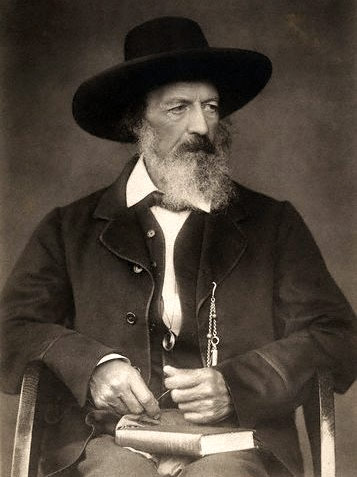
Tears, Idle Tears

Tears, idle tears, I know not what they mean,
Tears from the depth of some divine despair
Rise in the heart, and gather to the eyes,
In looking on the happy autumn-fields,
And thinking of the days that are no more.

Fresh as the first beam glittering on a sail,
That brings our friends up from the underworld,
Sad as the last which reddens over one
That sinks with all we love below the verge;
So sad, so fresh, the days that are no more.

Ah, sad and strange as in dark summer dawns
The earliest pipe of half-awaken'd birds
To dying ears, when unto dying eyes
The casement slowly grows a glimmering square;
So sad, so strange, the days that are no more.

Dear as remembered kisses after death,
And sweet as those by hopeless fancy feign'd
On lips that are for others; deep as love,
Deep as first love, and wild with all regret;
O Death in Life, the days that are no more!

Tennyson, from The Princess, published 1847
___________________________________________________

Wednesday, August 12, 2009

After a Stroke: Sun in an Empty Room

Still life (painting), there's still life...As in the hope of recovery. Hopper helped me get through some of the roughest patches of my post-episode convalescence. I know he's seen as a painter of loneliness, but the trinity of light is crucial.

"Whether we like it or not, we are all bound to the earth with our experience of life and the reactions of the mind, heart, and eye, and our sensations, by no means, consist entirely of form, color, and design." Edward Hopper, age 81

(This lightest of yellows is the exact color of my bedroom and the light falls in similar parallelograms).

Sunday, August 02, 2009

A Walk Through the Memory Palace


Announcing the finalists and winners of the First Annual Qarrtsiluni Chapbook Contest.

At the outset, let us say thank you: thank you to the poets who submitted fifty manuscripts of astounding variety and complexity to our contest, thank you to the first-round readers and to Dinty Moore, our 2009 judge for taking on the extremely difficult job of deciding among such excellent work. Choosing the poetry that speaks to us will always be, to some extent, subjective, and it’s not only possible but likely that a different set of judges would have come up with a different set of choices. Because of that subjectivity, and our own desire to encourage written expression, experimentation, and creativity, Dave and I have always had a love/hate affair with contests. So we want to congratulate and thank all the poets, and reiterate that the quality of the work – as is so often the case at qarrtsiluni - was very high, and the choice clearly difficult. We’ve learned a lot in doing this, and hope all of you will be thinking ahead to next year.

THE PROCESS: Eight first-round readers, all of whom are former guest editors of qarrtsiluni, read the fifty submitted manuscripts in order to narrow the field to a shortlist of no more than ten. Each chapbook, identified only by title, was read by at least two readers. A shortlist of ten anonymous manuscripts was then forwarded to Dinty Moore for his final decisions.

On September 1st, we’ll begin online publication of one poem from each of the shortlisted manuscripts, and the winning chapbook in its entirety. The winner will also be published in a professionally designed paper edition, and available for sale.

THE SHORTLIST:

Paper Covers Rock, Chella Courington
Calamity Jane, Diane Gage
The Three, Richard Garcia
Wavelengths, Dick Jones
Prison Terms, Diane Kendig
Influence of Two Moons, Kit Loney
The Goatfish Alphabet, Kristen McHenry
A Walk Through the Memory Palace, Pamela Johnson Parker
ashes, ashes, Susanna Rich
And Not As She Was, Jeneva Stone

THE WINNERS, with Dinty Moore’s comments:

First Prize:

A Walk Through the Memory Palace, by Pamela Johnson Parker

“The language is textured, clear, and sometimes disquieting, the images both sensory and sensual, and each line crafted with painstaking care. Whether writing about rich gardens, sagging breasts, or the ink of a tattoo, this poet sees through the obvious to something radiant on the other side, painting a startling portrait of an intimate world. Not a wasted word here: the nouns are like gemstones.

Pamela Johnson Parker is a medical editor and adjunct professor in creative writing and poetry. Her poems, flash fiction, and essays have appeared in or are forthcoming in qarrtsiluni, The Binnacle, The Other Journal, New Madrid, Pebble Lake Review, Holly Rose Review, 6 Sentences, Mipoesis, Muscadine Lines, A Journal of the South, and Anti-. She is also the featured poet in the April 2009 Broadsided series of poetry and art. A graduate of the MFA program at Murray State University, Parker lives in western Kentucky.

Pamela has had three poems published in qarrtsiluni previously.

Runners-Up:

Paper Covers Rock, by Chella Courington

“Crisp narrative lines filled with energy, indignation, and fierce beauty. The images can take your breath away, and the title poem is one I’ll never forget.”

With a Ph.D. in British and American Literature and an M.F.A. in Poetry, Chella Courington teaches writing and literature at Santa Barbara City College. Having moved west with a fiction writer and two cats in 2002, she finds that California provides her imaginative space. Her recent poetry appears in Mademoiselle’s Fingertips, Permafrost, wicked alice, Iguana Review, and The New Verse News. Her first chapbook, entitled Southern Girl Gone Wrong, was published in 2004. She’s new to the pages of qarrtsiluni.

The Goatfish Alphabet, by Kristen McHenry

“All manner of creatures combine in exuberant lines full of foxfire and jellyfish, rock-teeth and tongue-muzzle, Miss America, St. Clare of Assisi, and our frailest secrets disclosed. These are lovely poems.”

Kristen McHenry is a resident of Seattle, Washington and is a poet and freelance writer by night, and health outreach worker by day. Among other publications, her work has been seen in Wanderings, Trellis Magazine, Boston Literary Magazine, Tiferet, Sybil’s Garage, and several anthologies, including Meanderings and Flowers Bloom in the Moonlight. She is currently a finalist in the national competition “Project Verse”. She is the creator and facilitator of the Poet’s Cafe, a weekly poetry workshop for homeless teens at the New Horizons drop-in center in downtown Seattle.

Kristen lives in the Ballard neighborhood with two cats, two firebellied toads, and one husband. She loves to sing, but only in the car with all of the windows rolled up.

This will also be Kristen’s first publication in qarrtsiluni.

So there you have it. Stay tuned: we hope you’ll anticipate reading these poems in September as much as we look forward to publishing them.

——————————————————
Qarrtsiluni Chapbook Contest 2009

Final Judge: Dinty Moore

First-round Readers: Ivy Alvarez, Rachel Barenblat, Dale Favier, Brent Goodman, Tom Montag, Yemi Onafuwa, Peter Stephens, Carey Wallace

Contest Coordination and Print Publication: Beth Adams

Qarrtsiluni Managing Editors: Dave Bonta and Beth Adams

http://qarrtsiluni.com/2009/08/01/chapbook-contest-we-have-winners/


Widget_logo

Friday, July 31, 2009

"Beds of Bronzing As Harmful as the Tobacco"

La Tribune, a newspaper written in French, apparently turned to Babelfish to translate text for the English web version of its headlines. Click on the link above for more unintentional hilarity...

I think Babelfish may be the source for my other favorite French mistranslation. The wages-of-adultery film Unfaithful, which starred Diane Lane, Richard Gere, and Oliver Martinez, showed up in a French review as...Inaccurate. Thou shalt not commit inaccuracy might have to be the 11th commandment.

Here's something bronze, burning and tobacco related:

Thursday, July 30, 2009

Gratitude Journal: A Singular Entry


This week I have been cleared by my neurophysiologist to teach after possible strokes. From January through April 2009, I had at least 4 episodes that I thought were due to extreme fatigue but were in retrospect probably TIAs (mini strokes). On Memorial Day I had what Fred Sanford would call "The Big One, Elizabeth!" I was hospitalized for 5 days in the cardiac/neuro ward. Nothing showed up on my MRI, MRA, or CT to document strokes, but I had extreme weakness, trouble with speech, moving the right side of my body and using some fingers of my left hand. I also had (and still have to a minute degree) problems with language and concentration. I've worked really hard for the last 2 months to improve my speech, concentration, and physical health to get better. I can now read and concentrate for 3 hours at a time, which is less than half of what I could do before, but it's much much better. I didn't lose any written (reading or writing) skills except for lingering over a word sometimes--and I don't think that's a disadvantage for a poet.

I'm looking forward to reading and writing more in August. That's my vow--read more, walk more, and start to write again.

I'm really grateful for the opportunity.
BEST BOOKS THIS YEAR: Leslie Harrison's Displacement, Jericho Brown's Please

LOOKING FORWARD TO READING: Holly Goddard Jones' Girl Trouble (Harper Collins, short stories), Nicky Beer's The Diminishing House (Carnegie Mellon, poems)

Wednesday, July 22, 2009

Profiling in Massachusetts: Scholar Arrested


BOSTON (Reuters) - Authorities in Cambridge, Massachusetts on Tuesday dropped disorderly conduct charges against a preeminent black scholar stemming from an incident that drew fresh attention to police treatment of minorities in the United States.

Harvard University professor Henry Louis Gates was arrested at his home in the Boston suburb of Cambridge last Thursday by a white police officer after a woman called police to report that a man was trying to force his way into the house.

Gates, 58, had merely experienced difficulty opening his own front door after returning from a trip to China, according to his lawyer. But police said Gates exhibited "loud and tumultuous behavior," including accusing police of racism.

A statement on the Cambridge police department's Web site said, "The City of Cambridge, the Cambridge Police Department, and Professor Gates acknowledge that the incident of July 16, 2009 was regrettable and unfortunate."

"This incident should not be viewed as one that demeans the character and reputation of Professor Gates or the character of the Cambridge Police Department," the statement said, adding that the charges were dropped.

Gates is the director of Harvard's W.E.B. Du Bois Institute for African & African American Research and is one of the most prominent black scholars in the United States.

The incident renewed a debate over "racial profiling" and whether police in the United States treat blacks and other minorities differently than whites -- even after the election of the first black U.S. president in Barack Obama.

"I'm outraged that this could happen to me in my own home but I'm outraged that it could happen to any individual," Gates said in an interview with the Washington Post.

Gates, who is seeking an apology, called the incident "deeply painful and traumatic," and told the newspaper he would use it as the basis for a documentary on "racial profiling."

A statement from his lawyer, Charles Ogletree, released on Monday said Gates had been unable to enter his damaged front door after returning home from a trip to China. Ogletree, also a Harvard professor, said Gates managed to enter the house through the rear door, and his driver carried in his luggage.

After police arrived at the house, Ogletree said, Gates showed his Harvard identification and driver's license, and asked the policeman for his name and badge number. The police officer walked away, and when Gates followed him to the porch, he was arrested, Ogletree's statement said.

A police report said Gates initially refused to provide identification and after the officer explained he was investigating a reported break-in, shouted "this is what happens to black men in America."

The report said Gates made threats against the policeman, then followed the officer outside and yelled at him. He was then arrested.

(Reporting by Jason Szep and JoAnne Allen; Editing by Stacey Joyce and Will Dunham)
_________________
Although other articles, including one in the Christian Science Monitor, have presented the police department's point of view of this event as a "tempest in a teapot," I really think this is an example of racial profiling. I question:

1. Why wouldn't the officer provide his name and badge number? Doesn't that violate some sort of law?

2. Why wouldn't the officer apologize and leave as soon as he was shown identification proving that Professor Gates was standing in his own home?

3. Is it against the law to protest police presence in one's own home?

4. Isn't it part of a police officer's training to decrease, rather than increase, the tension in a situation?

Incidentally, the Commonwealth of Massachusetts has a law against racial profiling.

(photo above taken by one of Gates' neighbors at the time of his arrest)

Monday, July 13, 2009

Today in History: Romanticism and "Tintern Abbey Lines"


July 13, 1798
Wordsworth visits Tintern Abbey

While on a walking tour, William Wordsworth and his sister Dorothy visit a ruined church called Tintern Abbey.

The ruins inspired Wordsworth's poem "Tintern Abbey," in which Wordsworth articulated some of the fundamental themes of Romantic poetry, including the restorative power of nature. The poem appeared in Lyrical Ballads, with a Few Other Poems in 1798, which Wordsworth collaborated on with his friend and fellow poet Samuel Taylor Coleridge. The book, which also included Coleridge's Rime of the Ancient Mariner, sold out within two years. The book's second edition included an important preface that articulated the Romantic manifesto.

Wordsworth was born near England's Lake District in 1770. He lost his mother when he was eight, and his father died five years later. Wordsworth attended Cambridge, then traveled in Europe, taking long walking tours with friends through the mountains. During his 20s, Wordsworth lived with his sister Dorothy and became close friends with Coleridge.

In 1802, after years of living on a modest income, Wordsworth came into a long-delayed inheritance from his father and was able to live comfortably with his sister. He married their longtime neighbor Mary Hutchinson and had five children. The poet's stature grew steadily, although most of his major work was written by 1807. In 1843, he was named poet laureate of England, and he died in 1850, at the age of 80.

Thursday, July 09, 2009

This Day in History: July 9, 1948 and 1957


July 9, 1948--Satchel Paige makes debut with Cleveland Indians

On this day in 1948, 42-year-old Leroy "Satchel" Paige pitches two innings for the Cleveland Indians in his debut with the newly--and barely--integrated American League. The game came 21 years after the great pitcher’s first Negro League appearance.

Leroy Page was born on July 7, 1906, in Mobile, Alabama. Page’s family changed the spelling of their name to Paige to differentiate themselves from John Page, Leroy’s absent and abusive father. "Satchel" got his nickname as a boy while working as a luggage carrier at the Mobile train station. When he was 12, his constant truancy coupled with a shoplifting incident got him sent to the Industrial School for Negro Children in Mount Meigs, Alabama. It turned out to be a lucky break, as it was there that Paige learned to pitch. After leaving the school, he turned pro.

From 1927 to 1948 Satchel Paige was the baseball equivalent of a hired gun: He pitched for any team in the United States or abroad that could afford him. He was the highest paid pitcher of his time, and he wowed crowds with the speed of his fastball, his trick pitches and his considerable bravado. Just for fun, Paige would sometimes call in his outfield and then strike out the side. From 1939 to 1942, the Kansas City Monarchs paid up for his services and were justly rewarded: Paige led the team to four consecutive Negro American League pennants from 1939 to 1942. In the 1942 Negro League World Series, Satchel won three games in a four-game sweep of the Homestead Grays, led by famed slugger Josh Gibson.

Paige’s contract was bought by Bill Veeck’s Cleveland Indians on July 7, 1948, his 42nd birthday. He made his major league debut two days later, entering in the fifth inning against the St. Louis Browns with the Indians trailing 4-1. He gave up two singles in two innings, striking one man out and inducing one batter to hit into a double play. The Indians lost the game 5-3 in spite of Paige’s contribution. That year Satchel Paige went 6-1 with a solid 2.48 ERA for the World Champion Cleveland Indians.

Paige was named to Major League Baseball’s All-Star Team for the American League in 1952 and 1953, when he was 46 and 47 years old respectively. In 1965, Paige pitched for the Kansas City Athletics, which made him, at 59 years, 2 months and 18 days, the oldest pitcher ever to play a game in the major leagues. Arguably the greatest pitcher of his era, Paige was inducted into the Baseball Hall of Fame in 1971.

________________
Today's my birthday, and here are some quotes from Satchel that I find extremely pertinent:

Work like you don't need the money. Love like you've never been hurt. Dance like nobody's watching.

Age is a case of mind over matter. If you don't mind, it don't matter.

I've said it once and I'll say it a a hundred times, I'm forty-four years old
.

Don't look back. Something might be gaining on you.


Satchel Paige

Monday, July 06, 2009

Letters from a Young Composer, 1812: Ewig Dein, Ewig Mein, Ewig Uns

Morning, Monday, July 6

My angel, my all, my very self — Only a few words today and at that with pencil (with yours) … Oh God, look out into the beauties of nature and comfort your heart with that which must be — Love demands everything and that very justly — thus it is to me with you, and to your with me. … We shall surely see each other soon; moreover, today I cannot share with you the thoughts I have had during these last few days touching my own life — If our hearts were always close together, I would have none of these. My heart is full of so many things to say to you — ah — there are moments when I feel that speech amounts to nothing at all — Cheer up — remain my true, my only treasure, my all as I am yours. The gods must send us the rest, what for us must and shall be —
Your faithful LUDWIG

Evening, Monday, July 6

Wherever I am, there you are also — I will arrange it with you and me that I can live with you. What a life!!! thus!!! without you — pursued by the goodness of mankind hither and thither — which I as little want to deserve as I deserve it — Humility of man towards man — it pains me — and when I consider myself in relation to the universe, what am I and what is He — whom we call the greatest — and yet — herein lies the divine in man — I weep when I reflect that you will probably not receive the first report from me until Saturday - Much as you love me — I love you more — But do not ever conceal yourself from me — good night — As I am taking the baths I must go to bed — Oh God — so near! so far! Is not our love truly a heavenly structure, and also as firm as the vault of heaven?

Good morning, on July 7

Oh God, why must one be parted from one whom one so loves. And yet my life in V is now a wretched life — Your love makes me at once the happiest and the unhappiest of men — At my age I need a steady, quiet life — can that be so in our connection? Be calm — love me — today — yesterday — what tearful longings for you — you — you — my life — my all — farewell. Oh continue to love me — never misjudge the most faithful heart of your beloved.


ever thine
ever mine
ever ours

Sunday, July 05, 2009

This Day in History: The First Bikini

July 5: General Interest--1946 : Bikini introduced

On July 5, 1946, French designer Louis Reard unveils a daring two-piece swimsuit at the Piscine Molitor, a popular swimming pool in Paris. Parisian showgirl Micheline Bernardini modeled the new fashion, which Reard dubbed "bikini," inspired by a news-making U.S. atomic test that took place off the Bikini Atoll in the Pacific Ocean earlier that week.

European women first began wearing two-piece bathing suits that consisted of a halter top and shorts in the 1930s, but only a sliver of the midriff was revealed and the navel was vigilantly covered. In the United States, the modest two-piece made its appearance during World War II, when wartime rationing of fabric saw the removal of the skirt panel and other superfluous material. Meanwhile, in Europe, fortified coastlines and Allied invasions curtailed beach life during the war, and swimsuit development, like everything else non-military, came to a standstill.

In 1946, Western Europeans joyously greeted the first war-free summer in years, and French designers came up with fashions to match the liberated mood of the people. Two French designers, Jacques Heim and Louis Reard, developed competing prototypes of the bikini. Heim called his the "atom" and advertised it as "the world's smallest bathing suit." Reard's swimsuit, which was basically a bra top and two inverted triangles of cloth connected by string, was in fact significantly smaller. Made out of a scant 30 inches of fabric, Reard promoted his creation as "smaller than the world's smallest bathing suit." Reard called his creation the bikini, named after the Bikini Atoll.

In planning the debut of his new swimsuit, Reard had trouble finding a professional model who would deign to wear the scandalously skimpy two-piece. So he turned to Micheline Bernardini, an exotic dancer at the Casino de Paris, who had no qualms about appearing nearly nude in public. As an allusion to the headlines that he knew his swimsuit would generate, he printed newspaper type across the suit that Bernardini modeled on July 5 at the Piscine Molitor. The bikini was a hit, especially among men, and Bernardini received some 50,000 fan letters.


Before long, bold young women in bikinis were causing a sensation along the Mediterranean coast. Spain and Italy passed measures prohibiting bikinis on public beaches but later capitulated to the changing times when the swimsuit grew into a mainstay of European beaches in the 1950s. Reard's business soared, and in advertisements he kept the bikini mystique alive by declaring that a two-piece suit wasn't a genuine bikini "unless it could be pulled through a wedding ring."

In prudish America, the bikini was successfully resisted until the early 1960s, when a new emphasis on youthful liberation brought the swimsuit en masse to U.S. beaches. It was immortalized by the pop singer Brian Hyland, who sang "Itsy Bitsy Teenie Weenie Yellow Polka-Dot Bikini" in 1960, by the teenage "beach blanket" movies of Annette Funicello and Frankie Avalon, and by the California surfing culture celebrated by rock groups like the Beach Boys. Since then, the popularity of the bikini has only continued to grow.

Whirring Rubies

XV.

A Route of Evanescence
With a revolving Wheel--
A Resonance of Emerald--
A Rush of Cochineal--
And every Blossom on the Bush
Adjusts its tumbled Head--
The mail from Tunis, probably,
An easy Morning's Ride--

Emily Dickinsonn


This is an astounding video of hummingbirds in flight, feeding fledglings in a nest, taking nectar while a man holds a flower, etc. The longer it goes, the better it gets. Don't miss the last 90 seconds!

Friday, July 03, 2009

Happy Fourth--"American Names," Stephen Vincent Benet


I have fallen in love with American names,
The sharp names that never get fat,
The snakeskin-titles of mining-claims,
The plumed war-bonnet of Medicine Hat,
Tucson and Deadwood and Lost Mule Flat.

Seine and Piave are silver spoons,
But the spoonbowl-metal is thin and worn,
There are English counties like hunting-tunes
Played on the keys of a postboy’s horn,
But I will remember where I was born.

I will remember Carquinez Straits,
Little French Lick and Lundy’s Lane,
The Yankee ships and the Yankee dates
And the bullet-towns of Calamity Jane.
I will remember Skunktown Plain.

I will fall in love with a Salem tree
And a rawhide quirt from Santa Cruz,
I will get me a bottle of Boston sea
And a blue-gum nigger to sing me blues.
I am tired of loving a foreign muse.

Rue des Martyrs and Bleeding-Heart-Yard,
Senlis, Pisa, and Blindman’s Oast,
It is a magic ghost you guard
But I am sick for a newer ghost,
Harrisburg, Spartanburg, Painted Post.

Henry and John were never so
And Henry and John were always right?
Granted, but when it was time to go
And the tea and the laurels had stood all night,
Did they never watch for Nantucket Light?

I shall not rest quiet in Montparnasse.
I shall not lie easy at Winchelsea.
You may bury my body in Sussex grass,
You may bury my tongue at Champmedy.
I shall not be there. I shall rise and pass.
Bury my heart at Wounded Knee.

Thursday, July 02, 2009

Mayfield Man Makes Good: The Chicken Catcher on America's Got Talent

Beautiful, heartfelt country music from a Mayfield person. Harvey and I were shopping at a local store when we read a billboard saying, "Good Luck, Chicken Catcher!" We had no idea how wonderful he'd sound. Follow the link above to hear the accent from my part of the world--love it!

Here's the article from People:

AMERICA'S GOT TALENT:
From Chicken Catcher to Country Star?
July 1, 2009

Hiding behind a backwards cap, Kevin Skinner, 35, wowed judges with his brilliant guitar playing and singing. But expectations were low when the “chicken catcher” from Mayfield, Ky., stepped out onto the America’s Got Talent stage Tuesday. He drew mostly snickers from the crowd for his folksy wit when he said he likes to hunt and fish, “take the truck muddin’,” and count the stars under the open sky.
His version of “If Tomorrow Never Comes” by Garth Brooks had such a sophisticated and tortured sound, the unemployed farmer beamed with pure talent in a Susan Boyle-like breakout moment that may not become a YouTube sensation, but is definitely worthy of top-ranking performance of the season.
Piers Morgan, who sets the tone on the judges’ panel as the cranky expert, had nothing but praise for Skinner. “There is a moment in every season and I can remember them all, where somebody comes onstage dressed like you are, and your cap is on the wrong way around, and … then you start to sing and within about 20 seconds, you had me,” he said. “By the end of it, that was one of the most emotional powerful performances I’ve seen in a long time.”
Sharon Osbourne agreed: “I thought you were going to be really hokey and silly,” she said. “But I can tell you’re a really lovely person. You’re a very genuine man.”
Skinner got his ticket to Vegas.


Widget_logo

From Simon to Stallone: Today's Word--Petrichor

From Dr. Goodword, July 1, 2009

petrichor

Pronunciation: pe-trê-kor • Hear it!

Part of Speech
: Noun


Meaning: That distinctively pleasant fragrance of rain falling on dry ground. It is produced by oily, yellow-gold globules, rather like perfume, that either come from certain plants or the air itself.

Notes: This amazingly beautiful word was introduced by two Australian geologists, I. J. Bear and R. G. Thomas, in a 1964 article that appeared in Nature (993/2), referring to a rather specific aroma. However, we have all experienced the pleasure of the smell of rain against dry earth; now, we have a word to explain that pleasure. It is too young to have progeny yet, but when it reaches appropriate seniority, I predict it will produce an adjective, petrichoric.

In Play: This word certainly belongs in the vocabulary of all terroirists, "I'm certain that the bouquet of this chardonnay comes from the petrichor of the soil where the vines grew." But once we are comfortable with it, we can unleash our metaphoric creativity, "Her entrance into his life was a refreshing petrichor ending a long season of dry relationships."

Word History: It is amazing how such a beautiful word can arise from such a distasteful combination as today's extremely Good Word. It comprises the root of Greek petros "stone" + ichor, the mythical rarified fluid that flowed in the veins of the gods. (Ichor now refers to any watery discharge from a wound or inflammation.) Petros is also the Greek form of the name "Peter," which is why Jesus claimed him to be the rock on which His church would be built. So the name of the film character, Rocky, is simply a translation of the Greek Peter.

____________
I love this word! From the dry rock's and the blood of the gods, there's this phenomenal scent. It sends my mind all skimble-skamble (today's other word).

Wednesday, July 01, 2009

Adieu, Karl Malden (1912-2009)


This is a bad week for Gary, Indiana, natives. Malden worked in the steel mills of Gary before serving in World War II. Michael Jackson was a native of Gary.

Malden was superb in many of his roles, but it's A Streetcar Named Desire where he excelled, both on stage and on screen. He won a Tony for this role, which he originated on Broadway, and reprised it on film, winning an Acadamy Award for Best Supporting actor.

"A Room in the Past"--Ted Kooser

It’s a kitchen. Its curtains fill
with a morning light so bright
you can’t see beyond its windows
into the afternoon. A kitchen
falling through time with its things
in their places, the dishes jingling
up in the cupboard, the bucket
of drinking water rippled as if
a truck had just gone past, but that truck
was thirty years. No one’s at home
in this room. Its counter is wiped,
and the dishrag hangs from its nail,
a dry leaf. In housedresses of mist,
blue aprons of rain, my grandmother
moved through this life like a ghost,
and when she had finished her years,
she put them all back in their places
and wiped out the sink, turning her back
on the rest of us, forever.


I've linked to Kooser reading "A Room in the Past," which I find lovely and compelling. Throughout the poem, the grandmother is never presented head-on. She's seen peripherally, moving through life in housedresses of mist,/blue aprons of rain. In all of the chores that she completes--putting away the dishes, cleaning off the counters, wiping out the sink (the last thing I do when I clean my own kitchen)--her back is turned toward the rest of the family. Now that the light is bright and the room spotlit by sun, her kitchen and, by extension, her absence become more noticeable. What has defined her no longer contains her. Just as the mist is evaporated and the end of rain signaled by sun, she's quietly vanished. That metaphor of the dishrag....a dry leaf is particularly haunting to me.

Tuesday, June 30, 2009

Artist Manifesto: Carrie Ann Baade

Q. Do you have any words of wisdom, or bits of advice for our readers thinking about pursuing art full time?

A. DO NOT BECOME AN ARTIST.

If you can do something else, do it. However, if this is what you are, god love you, it will never be an easy path. Our eyes, our hands, our minds are committed to service. It is a calling. It will demand every sacrifice of you as you serve. If this is what you are, it was never a choice to do anything else. I am not talking to those of you who create merely out moods or in seasons or way back when. I am speaking to you give blood on a regular basis. Every battle you fight, every sacrifice made to insure your survival proves your conviction that no one and nothing can tear you from your station. This is an honor. To create HERE and NOW. To be the eyes the soul of your time. We are so very privileged to have all our opportunities; this exquisite FREEDOM to express, to adorn, and to synthesize the world we live in. Humble yourself to this calling, serve with passion. Suck the marrow out life! Transform another mind, bring beauty down from the mountain to the cities of men, challenge values, and raise awareness of what it is, to be a part of this human condition. Your reward will be the singing of the stars, the humming of the spheres. To toil in the duty of tribute to culture. To live an extraordinary existence!

I challenge you TO FAIL. Fail magnificently! For it is the only way to succeed. When you finally find success it is a shock to find that this is the first in a long line proving yourself…success is a process that pushes you to out do yourself without limit or end. As you succeed, I challenge you do so with humility and help those that who are climbing with you or behind you. If you can mentor, give someone the advice or confidence no one maybe ever gave you. Succeed so that you may be a shining example of the possible glory of being human, of being a creator. It is so much richer an existence to find yourself among friends than to find yourself alone. We are on this path together.

PS: To those who do not create art, I challenge you to support a living artist and become a collector. Artists are nothing without the belief of another person who values what they are putting into this world. You make a difference. Patronage keeps art alive. There are those amazing few who have come forward for me, they sustain me and fuel my ability to continue. If no one ever came forward for me, I would not be where I am now. To paraphrase Gertrude Stein in the Moveable Feast: - do not buy nice things, do not buy clothes, or expensive food, buy art. This is what is meaningful in this world. Invest in your culture. The artist does not need their creation. They made it for one person, the one to whom it belongs. The one person who resonates with the piece and cannot imagine their life without it.

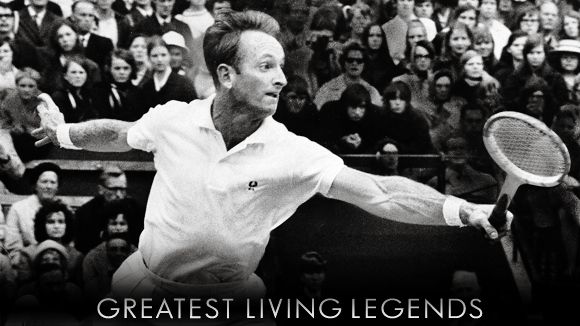
Rocket Man


2 Grand Slams (calendar). 11 major singles titles (even though banned from playing Grand Slam tournaments from age 24 to age 29 due to his status as a professional). 20 major championships in all (including doubles and mixed doubles). 47 total professional singles titles.

How can anyone deny that Rod Laver was the greatest?

5 feet 8 inches, and a wrist as big as heavyweight champion Sonny Liston.

Monday, June 29, 2009

Today's Writer's Almanac: Billy Collins

The Effort--Billy Collins (from Ballistics)

Would anyone care to join me
in flicking a few pebbles in the direction
of teachers who are fond of asking the question:
"What is the poet trying to say?"

as if Thomas Hardy and Emily Dickinson
had struggled but ultimately failed in their efforts—
inarticulate wretches that they were,
biting their pens and staring out the window for a clue.

Yes, it seems that Whitman, Amy Lowell
and the rest could only try and fail
but we in Mrs. Parker's third-period English class
here at Springfield High will succeed

with the help of these study questions
in saying what the poor poet could not,
and we will get all this done before
that orgy of egg salad and tuna fish known as lunch.

Tonight, however, I am the one trying
to say what it is this absence means,
the two of us sleeping and waking under different roofs.
The image of this vase of cut flowers,

not from our garden, is no help.
And the same goes for the single plate,
the solitary lamp, and the weather that presses its face
against these new windows--the drizzle and the morning frost.

So I will leave it up to Mrs. Parker,
who is tapping a piece of chalk against the blackboard,
and her students—a few with their hands up,
others slouching with their caps on backwards—

to figure out what it is I am trying to say
about this place where I find myself
and to do it before the noon bell rings
and that whirlwind of meatloaf is unleashed.

Resolutions:
(1) Don't be the Mrs. Parker who says this in third-period English.

(2) Remember Yoda: Do or do not...there is no try.

Friday, June 26, 2009

"Never Land"--Yusef Kumunyakaa

I don't wish you were one
of The Jackson Five
tonight, only you were

still inside yourself
unchanged by the vampire
moonlight. So eager to

play The Other,
did you forget
Dracula was singled out

because of his dark hair
& olive skin? After
you became your cover,

tabloid headlines
grafted your name
to a blond boy's.

The personals bled
through newsprint,
across your face. Victor

Frankenstein knew we must
love our inventions. Now,
maybe skin will start to grow

over the lies & subtract
everything that under-
mines nose & cheekbone.

You could tell us if
loneliness is what
makes the sparrow sing.

Michael, don't care
what the makeup
artist says, you know

your sperm will never
reproduce that face
in the oval mirror.

Wednesday, June 24, 2009

Reading Weldon Kees, Photo of Weldon Kees Reading


1926--Weldon Kees

The porchlight coming on again,
Early November, the dead leaves
Raked in piles, the wicker swing
Creaking. Across the lots
A phonograph is playing Ja-Da.

An orange moon. I see the lives
Of neighbors, mapped and marred
Like all the wars ahead, and R.
Insane, B. with his throat cut,
Fifteen years from now, in Omaha.

I did not know them then.
My airedale scratches at the door.
And I am back from seeing Milton Sills
And Doris Kenyon. Twelve years old.
The porchlight coming on again.
_____________

The photograph above is of Weldon Kees reading from the work of poet Henry Reed. It's haunting--Kees in a World War I uniform, and his shadow pendant.

Tuesday, June 23, 2009

More and More: Words of Advice from DRJ


Here are the comments of my son, Daniel, when he was three and saw Alice in Wonderland for the first time: "So...don't eat nothing, don't drink nothing, and don't go through any little doors..."

Words to live by!

Pushing Yourr Buttons

It was on this day in 1868 that the typewriter was patented, by Christopher Sholes in Milwaukee, Wisconsin. In 1873, he sold the patent to the Remington Arms Co., a famous gun maker, for $12,000. There had been typewriters before, but they weren't very practical — it took longer to type a letter than to write it by hand. The first commercial typewriter based on Sholes' design, a Remington Model 1, went on the market in 1874. (information from today's Writer's Almanac)


The Writer
by Richard Wilbur

In her room at the prow of the house
Where light breaks, and the windows are tossed with linden,
My daughter is writing a story.

I pause in the stairwell, hearing
From her shut door a commotion of typewriter-keys
Like a chain hauled over a gunwale.

Young as she is, the stuff
Of her life is a great cargo, and some of it heavy:
I wish her a lucky passage.

But now it is she who pauses,
As if to reject my thought and its easy figure.
A stillness greatens, in which

The whole house seems to be thinking,
And then she is at it again with a bunched clamor
Of strokes, and again is silent.

I remember the dazed starling
Which was trapped in that very room, two years ago;
How we stole in, lifted a sash

And retreated, not to affright it;
And how for a helpless hour, through the crack of the door,
We watched the sleek, wild, dark

And iridescent creature
Batter against the brilliance, drop like a glove
To the hard floor, or the desk-top,

And wait then, humped and bloody,
For the wits to try it again; and how our spirits
Rose when, suddenly sure,

It lifted off from a chair-back,
Beating a smooth course for the right window
And clearing the sill of the world.

It is always a matter, my darling,
Of life or death, as I had forgotten. I wish
What I wished you before, but harder.

Sunday, June 21, 2009

“Soon I’ll go berry-picking, and when I go I’ll take my language with me.”


Watch this fascinating video on the loss of the world's languages and its effects on culture, science, and ecosystems. It's a fascinating and sometimes heartbreaking video.

Only in America: Happy Father's Day


* More collect calls are placed on Father's Day than any other day of the year.

* The Stevie Wonder song "Isn't She Lovely" isn't about a woman he's lusting for; it's about his newborn daughter Aisha! If you listen closely, you can hear Aisha crying during the song.

* Kurt Vonnegut was (for a short time) Geraldo Rivera's father-in-law. Rivera's marriage to Edith Vonnegut ended in 1974 because of his womanizing. Her ever-protective father was quoted as saying, "If I see Gerry again, I'll spit in his face." He also included an unflattering character named Jerry Rivers (a chauffeur) in a few of his books.

(facts from Mental Floss--link above)

Saturday, June 20, 2009

Tim Burton's Alice in Wonderland


This is among my favorite books: I cannot wait to see what Tim Burton does with this cast and set design. Alice looks beautiful in Alice blue (which is named after A. Roosevelt, not A. in W.)! Click on the link above for more photographs from the movie.


Widget_logo