Introverted iNtuitive Feeling Judging
Beneath the quiet exterior, INFJs hold deep convictions about the weightier matters of life. Those who are activists -- INFJs gravitate toward such a role -- are there for the cause, not for personal glory or political power.
INFJs are champions of the oppressed and downtrodden. They often are found in the wake of an emergency, rescuing those who are in acute distress. INFJs may fantasize about getting revenge on those who victimize the defenseless. The concept of 'poetic justice' is appealing to the INFJ.
"There's something rotten in Denmark." Accurately suspicious about others' motives, INFJs are not easily led. These are the people that you can rarely fool any of the time. Though affable and sympathetic to most, INFJs are selective about their friends. Such a friendship is a symbiotic bond that transcends mere words.
INFJs have a knack for fluency in language and facility in communication. In addition, nonverbal sensitivity enables the INFJ to know and be known by others intimately.
Writing, counseling, public service and even politics are areas where INFJs frequently find their niche.
Functional Analysis:
Introverted iNtuition
Introverted intuitives, INFJs enjoy a greater clarity of perception of inner, unconscious processes than all but their INTJ cousins. Just as SP types commune with the object and "live in the here and now" of the physical world, INFJs readily grasp the hidden psychological stimuli behind the more observable dynamics of behavior and affect. Their amazing ability to deduce the inner workings of the mind, will and emotions of others gives INFJs their reputation as prophets and seers. Unlike the confining, routinizing nature of introverted sensing, introverted intuition frees this type to act insightfully and spontaneously as unique solutions arise on an event by event basis.
Extraverted Feeling
Extraverted feeling, the auxiliary deciding function, expresses a range of emotion and opinions of, for and about people. INFJs, like many other FJ types, find themselves caught between the desire to express their wealth of feelings and moral conclusions about the actions and attitudes of others, and the awareness of the consequences of unbridled candor. Some vent the attending emotions in private, to trusted allies. Such confidants are chosen with care, for INFJs are well aware of the treachery that can reside in the hearts of mortals. This particular combination of introverted intuition and extraverted feeling provides INFJs with the raw material from which perceptive counselors are shaped.
Introverted Thinking
The INFJ's thinking is introverted, turned toward the subject. Perhaps it is when the INFJ's thinking function is operative that he is most aloof. A comrade might surmise that such detachment signals a disillusionment, that she has also been found lacking by the sardonic eye of this one who plumbs the depths of the human spirit. Experience suggests that such distancing is merely an indication that the seer is hard at work and focusing energy into this less efficient tertiary function.
Extraverted Sensing
INFJs are twice blessed with clarity of vision, both internal and external. Just as they possess inner vision which is drawn to the forms of the unconscious, they also have external sensing perception which readily takes hold of worldly objects. Sensing, however, is the weakest of the INFJ's arsenal and the most vulnerable. INFJs, like their fellow intuitives, may be so absorbed in intuitive perceiving that they become oblivious to physical reality. The INFJ under stress may fall prey to various forms of immediate gratification. Awareness of extraverted sensing is probably the source of the "SP wannabe" side of INFJs. Many yearn to live spontaneously; it's not uncommon for INFJ actors to take on an SP (often ESTP) role.
Famous INFJs:
Chaucer
Goethe
Robert Burns
Nathaniel Hawthorne
Martin Luther King, Jr., civil rights leader, martyr
James Reston, newspaper reporter
Garry Trudeau (Doonesbury)
Nelson Mandela
______
INFJs are distinguished by both their complexity of character and the unusual range and depth of their talents. Strongly humanitarian in outlook, INFJs tend to be idealists, and because of their J preference for closure and completion, they are generally "doers" as well as dreamers. This rare combination of vision and practicality often results in INFJs taking a disproportionate amount of responsibility in the various causes to which so many of them seem to be drawn.
INFJs are deeply concerned about their relations with individuals as well as the state of humanity at large. They are, in fact, sometimes mistaken for extroverts because they appear so outgoing and are so genuinely interested in people -- a product of the Feeling function they most readily show to the world. On the contrary, INFJs are true introverts, who can only be emotionally intimate and fulfilled with a chosen few from among their long-term friends, family, or obvious "soul mates." While instinctively courting the personal and organizational demands continually made upon them by others, at intervals INFJs will suddenly withdraw into themselves, sometimes shutting out even their intimates. This apparent paradox is a necessary escape valve for them, providing both time to rebuild their depleted resources and a filter to prevent the emotional overload to which they are so susceptible as inherent "givers." As a pattern of behavior, it is perhaps the most confusing aspect of the enigmatic INFJ character to outsiders, and hence the most often misunderstood -- particularly by those who have little experience with this rare type.
Due in part to the unique perspective produced by this alternation between detachment and involvement in the lives of the people around them, INFJs may well have the clearest insights of all the types into the motivations of others, for good and for evil. The most important contributing factor to this uncanny gift, however, are the empathic abilities often found in Fs, which seem to be especially heightened in the INFJ type (possibly by the dominance of the introverted N function).
This empathy can serve as a classic example of the two-edged nature of certain INFJ talents, as it can be strong enough to cause discomfort or pain in negative or stressful situations. More explicit inner conflicts are also not uncommon in INFJs; it is possible to speculate that the causes for some of these may lie in the specific combinations of preferences which define this complex type. For instance, there can sometimes be a "tug-of-war" between NF vision and idealism and the J practicality that urges compromise for the sake of achieving the highest priority goals. And the I and J combination, while perhaps enhancing self-awareness, may make it difficult for INFJs to articulate their deepest and most convoluted feelings.
Usually self-expression comes more easily to INFJs on paper, as they tend to have strong writing skills. Since in addition they often possess a strong personal charisma, INFJs are generally well-suited to the "inspirational" professions such as teaching (especially in higher education) and religious leadership. Psychology and counseling are other obvious choices, but overall, INFJs can be exceptionally difficult to pigeonhole by their career paths. Perhaps the best example of this occurs in the technical fields. Many INFJs perceive themselves at a disadvantage when dealing with the mystique and formality of "hard logic", and in academic terms this may cause a tendency to gravitate towards the liberal arts rather than the sciences. However, the significant minority of INFJs who do pursue studies and careers in the latter areas tend to be as successful as their T counterparts, as it is *iNtuition* -- the dominant function for the INFJ type -- which governs the ability to understand abstract theory and implement it creatively.
In their own way, INFJs are just as much "systems builders" as are INTJs; the difference lies in that most INFJ "systems" are founded on human beings and human values, rather than information and technology. Their systems may for these reasons be conceptually "blurrier" than analogous NT ones, harder to measure in strict numerical terms, and easier to take for granted -- yet it is these same underlying reasons which make the resulting contributions to society so vital and profound.
Monday, January 31, 2011


Alan Lomax: The Writer's Almanac Entry

On Gathering Music:
"Our way of work is simple. From letters and books and word of mouth, we hear of someone, perhaps a Vermont woodsman or a Kentucky miner, who knows a store of old folk tunes. We get into our car and go to visit him. But my father and I don't burst in like college professors in search of quaintness. We make friends. We live in the neighborhood. And before we even go to a place, we find out about the kind of work in that section so that we can talk about it. Only then do we go and ask for songs. [...] Generally the reaction of people is friendly. They're proud you consider their music important, and they want to do the best job possible. I remember one Finnish singer in the Middle West, from whom we were recording a song about a Finnish Robin Hood. It took 20 minutes to sing. When we had cut the record, we played it back for him. His sharp ears discovered one tiny mistake, and he was so eager for perfection that he made us do the entire record over again."
On Lead Belly:
The Lomaxes went to the Louisiana State Penitentiary, where they met Huddie William Ledbetter, better known as Lead Belly. Lomax wrote: "I'll never forget: He approached us all the way from the building where he worked, with his big twelve-string guitar in his hand. He sat down in front of us and proceeded to sing everything that we could think of in this beautiful, clear, trumpet-like voice that he had, with his hand simply flying on the strings. His hands were like a whirlwind, and his voice was like a great clear trumpet. You could hear him, literally, half a mile away when he opened up."
Lead Belly had been playing music since he was a kid with an accordion, and entertained his fellow inmates with his concerts. The Lomaxes were so impressed with Lead Belly that they cut a whole record of his singing, and they agreed to record a song he wrote for the governor of Louisiana, begging to get out of jail. The lyrics were: "In nineteen hundred an' thirty-two, / Honorable Guvner O.K. Allen, / I'm 'pealin' to you. / If I had you, Guvner O.K. Allen, / Like you got me, / I would wake up in de mornin', / Let you out on reprieve."
The Lomaxes took the song to Governor Oscar K. Allen, and not long afterwards Lead Belly was let out of prison — it was actually an early release for good behavior, but both Lead Belly and the Lomaxes thought the song had helped. After that, the Lomaxes helped put Lead Belly in the national spotlight.
On What's Beautiful: The Radio Year
Alan and John Lomax headed up the Library of Congress "Archive of American Folk Song," recording and preserving thousands of songs. Alan was particularly interested in doing more extensive interviews with their subjects, and he recorded the oral histories of musicians like Lead Belly, Woody Guthrie, Jelly Roll Morton, Muddy Waters, and Vera Hall.
In August of 1940, Alan started a prime-time radio program called Back Where I Come From. The first episode was hosted by literary critic Clifton Fadiman and featured Woody Guthrie, Burl Ives, Len Doyle, Josh White, and the Golden Gate Quartet. Performers took turns saying, "Back where I come from, we always say..." and filling it in with a local saying. Each episode was centered around a particular theme — for the first episode, it was "weather." The cast sang "It Ain't Gonna Rain No More," "The Erie Canal," "The Foggy Dew," and "So Long, It's Been Good to Know You," which was interwoven with Guthrie's commentary about the Dust Bowl. Back Where I Come From aired three nights a week, for 15 minutes. Soon Pete Seeger signed on as well. Besides "Weather," other themes included "Jails," "Nonsense Songs," and "Love True and Careless." The cast and crew thought the show was a success, but CBS unexpectedly canceled it in February of 1941.
Lomax wrote to Guthrie: "Our agent William Morris told us we were set for life. And then the great paw of America reached out and stopped it: Mister William B. Paley said that he didn't want any of that goddamn hillbilly music on his network. And that was that." Guthrie replied: "Too honest again I suppose? Maybe not purty enough. O well, this country's a getting to where it cain't hear its own voice. Someday the deal will change."
Lomax also wrote:
"We now have cultural machines so powerful that one singer can reach everybody in the world, and make all the other singers feel inferior because they're not like him. Once that gets started, he gets backed by so much cash and so much power that he becomes a monstrous invader from outer space, crushing the life out of all the other human possibilities. My life has been devoted to opposing that tendency."
_____________
Does poetry--mine, yours, anyone else's--oppose the tendency that only one voice or one established way of writing is the voice we emulate?
Do we support one another's work and look for the beauty in it rather than the flaws, which often we ourselves share?
Is there a place for the Finnish Robin Hood in pop culture? Is there still a place for doing it over and over till you get it right?
What's your answer to Back where I come from, we always say...
That's my writing prompt for this week. Maybe you'll write about it too.
Sunday, January 30, 2011
A Little Fable--Franz Kafka

"Alas," said the mouse, "the whole world is growing smaller every day. At the beginning it was so big that I was afraid, I kept running and running, and I was glad when I saw walls far away to the right and left, but these long walls have narrowed so quickly that I am in the last chamber already, and there in the corner stands the trap that I must run into."
"You only need to change your direction," said the cat, and ate it up.
______
This shortest of stories has always scared the bejesus out of me, mainly because of the time period of its authorship--the rise of Fascism. (I"ve always wondered if Art Spiegelman read this. Harvey should have asked him that at AWP Chicago. I think they talked about India ink instead).
I have thought about this exemplum for years, and I've finally worked it into a poem, where my musings belong.
For a wonderful graphic version of this little fable, click on the link above.
Friday, January 28, 2011
WILLIE NELSON - Unchained Melody
I'm 44 years old, feeling frumpy and fractious, fearing fifty. About-to-be-five-year-old Raleigh is being her fairy-princess-self, demanding pink clothes to wear to the party we're going to attend. Harvey's fellow teachers are having a back-to-school get-together, and I dread it. We've just moved into our house; nothing is unpacked, nothing is completely painted, and nothing is organized; I just want to go to sleep. Lupus has its teeth deep in my bones, and I feel my IQ drop as much as my eyelids.
When we get to the party, I feel so ugly, so old. All these brand-new-23-year-old teachers in their short shorts--and me in a droopy gauze skirt and the only t-shirt I own that doesn't have paint on it. And, to top it off, there's karaoke. Karaoke!
Then Harvey--who never sings except at church or at family reunions--ambles over to the karaoke machine and picks out a song--this one. And he sings it perfectly--the Everly Brothers/Roy Orbison version--and he hits all the high notes and he looks at me the whole time he is singing and everyone in the room is looking at him and then at me and murmuring because it is awesome, it is the loveliest that he has ever sung, and it is all for me. I am aware that right that very second, in sickness and in poor health, that I am the most beautiful I will ever be in my life, because I am being seen by someone who loves me, who knows me, who I realize for the first time in 15 years will never ever leave me, who I realize will always love me till the day he dies.
And he did. And I do. And I thank Willie Nelson for singing this song with nearly as much tenderness as Harvey did.
Born Today: Colette

Love Letter to Marguerite Moreno, June 1925
What am I doing? Heavens, I'm spinning. And I use this verb as a planet would. Yes, I'm spinning.
I've seen roses, honeysuckle, forty degrees Centigrade of dazzling heat, moonlight, ancient wisteria enlacing the door of my old home in Saint-Sauveur.
I've seen the night over Fontainebleau. And as I said, I'm spinning.
Beside me there a is a dark boy at the wheel. I'm on my way back to Paris, but shall I stay there? The dark boy beside me is still at the wheel, and how strange everything is! And how good I am, and how amazed I am, and what wise improvidence in my behaviour! Oh yes, I'm spinning! As you can see, you must not worry about me.
From time to time I am uneasy about myself, and I give a start, prick up my ears, and cry out, But what are you doing? and then I refuse to think any more about it ... Just now, on the telephone, an enlightened Chiwawa, enlightened by the dark, dark, dark boy, sang my praises. The era of frankness is back and the cards are on the table.
But, my Marguerite, how strange it all is! ... I have the fleeting confidence of people who fall out of a clock tower and for a moment sail through the air in a comfortable fairy-world, feeling no pain anywhere ...
Colette
Thursday, January 27, 2011
"And a Sleep Full of Sweet Dreams": Ekphrasis 6
This is the poem I want read at my memorial service. I don't plan to have one for years and years, but just in case...
Wednesday, January 26, 2011
"A Bower Quiet for Us": Ekphrasis 5.

The Epitaph Ending in And
In the last storm, when hawks
blast upward and a dove is
driven into the grass, its broken wings
a delicate design, the air between
wracked thin where it stretched before,
a clear spring bent close too often
(that Earth should ever have such wings
burnt on in blind color!), this will be
good as an epitaph:
Doves did not know where to fly, and
William Stafford
Tuesday, January 25, 2011
"But Still Will Keep": Ekphrasis 4.

(Vanessa Bell's portrait of her sister, Virginia Woolf)
Some quotes from The Waves illustrate literary impressionism.
In my case something remains floating, unattached.
"On the outskirts of every agony sits some observant fellow who points."
"Now I will wrap my agony in my pocket-handkerchief."
Monday, January 24, 2011
It Will Never Pass Into Nothingness--Ekphrasis 3.

"Life is always a tightrope or a feather bed. Give me the tightrope."
This is the red-velvet portrait of Edith Wharton, born on this day in 1862.
"There are two ways of spreading light: to be the candle or the mirror that receives it."
Sunday, January 23, 2011
Its Loveliness Increases: Ekphrasis 2.

I own this print, plus two others, by amazing artist Carrie Ann Baade. Her art graces the cover of my first chapbook, A Walk Through the Memory Palace, and I would love to have an original painting by her.
Saturday, January 22, 2011

A Trio of Musings on Love and Marriage
I.

"There is another world, but it is in this one."
—W. B. Yeats
I will never know another person in this world as I knew Harvey, and no one else will ever know me as he did. There is the knowledge that is the body's, which grows the knowledge that is the soul's; and it is that becoming one flesh that shows me that I was put here for a reason: to give praise and pleasure to another person and thus to know the world, this world.
Earth's the right place for love. Robert Frost, "Birches"
_____
II.

"Knowledge is erotic."
—Jane Hirshfield
To know someone is the ultimate in erotic knowledge; as one partner continues to learn the other, all that knowledge helps love to deepen. It also keeps one's sex life vibrant. I know what someone else likes, and in terms of that like, what else might he desire? Someone knows my particular responses and is interested in what else will further that reciprocity.
Staying interested means staying sexy, even when the hair falls out and the jaw sags and the skin feels more like crepe paper than vellum. The palimpsest of those younger faces, younger bodies, continues to emerge at the strangest times. (It also helps to have, as I did, a partner who likes antiques. The older you get, the more weathered, original patina that remains--the more beautiful and valuable and valued you are)!
My beloved is mine, and I am his. (Song of Songs)
_____
III.

"Worrying is praying for what you don't want."
—Chris West
I tend to worry, even though I believe it is the deepest of sins (and belongs among the deadly ones). I've been told over and over and over again not to worry. This leads to meta-worrying. I am sick of it, as I am sick of loneliness. Don't Worry, Be Happy ought to be the hymn of atheist, agnostic and believer.
I worry that I'll never write another poem. I worry that my hair is turning grey. I worry that I'll never feel anything remotely like love for another person. Does worry make me write? No--it makes me afraid to try. Does worrying make me dishwater-blonder? No--it makes me examine my hair for its shade and not appreciate the fact that it is full and thick again, after years in my forties when it seemed so thin and lank. Does worry make me love? No--it puts me in a prayerful attitude where I'm asking the universe to recognize badness, when my repeated mantra opens me up for hurt. I'll never have that again, so why look at this?
I worry that I'll be alone for the next couple of decades and worry that I'll never have anyone to love or to love me again. That's not for me to say. I should remember that I had a great love and still have its warmth. A stone in the sun holds that heat well into the darkness. I still have moments when I bask in remembering how much Harvey and I loved each other. I should remember and celebrate and savor what I had, and I will, as long as I have it in mind.
I really was there/insists the self./Insists, insists. (That one's mine).


"There is another world, but it is in this one."
—W. B. Yeats
I will never know another person in this world as I knew Harvey, and no one else will ever know me as he did. There is the knowledge that is the body's, which grows the knowledge that is the soul's; and it is that becoming one flesh that shows me that I was put here for a reason: to give praise and pleasure to another person and thus to know the world, this world.
Earth's the right place for love. Robert Frost, "Birches"
_____
II.

"Knowledge is erotic."
—Jane Hirshfield
To know someone is the ultimate in erotic knowledge; as one partner continues to learn the other, all that knowledge helps love to deepen. It also keeps one's sex life vibrant. I know what someone else likes, and in terms of that like, what else might he desire? Someone knows my particular responses and is interested in what else will further that reciprocity.
Staying interested means staying sexy, even when the hair falls out and the jaw sags and the skin feels more like crepe paper than vellum. The palimpsest of those younger faces, younger bodies, continues to emerge at the strangest times. (It also helps to have, as I did, a partner who likes antiques. The older you get, the more weathered, original patina that remains--the more beautiful and valuable and valued you are)!
My beloved is mine, and I am his. (Song of Songs)
_____
III.

"Worrying is praying for what you don't want."
—Chris West
I tend to worry, even though I believe it is the deepest of sins (and belongs among the deadly ones). I've been told over and over and over again not to worry. This leads to meta-worrying. I am sick of it, as I am sick of loneliness. Don't Worry, Be Happy ought to be the hymn of atheist, agnostic and believer.
I worry that I'll never write another poem. I worry that my hair is turning grey. I worry that I'll never feel anything remotely like love for another person. Does worry make me write? No--it makes me afraid to try. Does worrying make me dishwater-blonder? No--it makes me examine my hair for its shade and not appreciate the fact that it is full and thick again, after years in my forties when it seemed so thin and lank. Does worry make me love? No--it puts me in a prayerful attitude where I'm asking the universe to recognize badness, when my repeated mantra opens me up for hurt. I'll never have that again, so why look at this?
I worry that I'll be alone for the next couple of decades and worry that I'll never have anyone to love or to love me again. That's not for me to say. I should remember that I had a great love and still have its warmth. A stone in the sun holds that heat well into the darkness. I still have moments when I bask in remembering how much Harvey and I loved each other. I should remember and celebrate and savor what I had, and I will, as long as I have it in mind.
I really was there/insists the self./Insists, insists. (That one's mine).

Friday, January 21, 2011
Snotornesse, Snottiness, and Sestinas

Wisdom, discernment, prudence--Old English snotor (snotornesse)
Wisdom, discernment, prudence--and snobbery. American English: snottiness.
I'm just musing--it's fascinating that the word has had a denigration of meaning, rather than an amelioration. Silly once meant blessed.
Sleep sand/dream dust: The medical term is gound. Tears, snot, drool--the medical term is rheuminess.
How fun it would be to have a sestina in which rheumy and roomy were end words. Poem toward Tears might be a good title. (Rue me. Rumi. Roomy. Rheumy. Kangaroo. Me/and watch me wallaby's feet, mate).
Onward and upward to the writing notebook. Gilgamesh is now under control, and I'm ready for more intense writing this weekend.
(Above: Cy Twombly, Crossings)
Visit She Writes

Thursday, January 20, 2011
Edward Hirsch Says Read and So Do I

"Read ... poems to yourself in the middle of the night. Turn on a single lamp and read them while you're alone in an otherwise dark room or while someone else sleeps next to you. Read them when you're wide awake in the early morning, fully alert. Say them over to yourself in a place where silence reigns and the din of the culture — the constant buzzing noise that surrounds us — has momentarily stopped. These poems have come from a great distance to find you."
Edward Hirsch, in today's Writer's Almanac
_____
Nickole Brown, one of the MFA mentors at Murray State this semester, advised me to read Jenny Boully. I started with some online poems. Here's a poem I've read to myself in the middle of the night, recalled as I swerved to miss deer and opossum on my commute to school, obsessed over whilst in the elevator between classes...I hope this poem comes to live with you for a little while, too.
(I am just crazy about the enjambed title, and I love the energy that leaving the doorjamb open gives the poem).
Without further ado, Jenny Boully:
The more Alice reaches out, the more her dream-rushes
disappear: one by one by one the darling scented rushes sink back into melt. In the dream stream, the boat glides past too quick, and there is no chance to gather the loveliest of the dream-rushes. No less satisfying was the old sheep: so many knitting needles, dozens and dozens all pierced into a ball of worsted, and there was never ever any telling of just what, even in dream, it might be that the old sheep was knitting.
For years, I dreamt of the child who, when I reached out to her, turned into a sheet of paper, and so, in waking hours, I wrote and wrote and wrote and my friends consoled me: see, you have book babies; this, while I looked on at other women who knit bibs and booties, so many booties, such small socks.
When Alice steals away and consoles the Duchess's baby, it metamorphoses into a pig and runs away from her, runs away. That is ever so much a better-known story than the one of dream-rushes or too many knitting needles. (How ever did Alice ever console herself? Did her friends say, Oh, just think now you'll have truffles!?)
Odysseus's mother wonders how her son, a mere mortal, made it over Oceanus to the land where lives sink back into melt. She says that he must have had a good boat; he tries to embrace her, but like a soul she flits about and away. When Odysseus asks why Mother, why not stay still and let us embrace, she says, Son, it's because I no longer have sinew, no longer have bones.
My little baby, who I will name a weaver of spools and not of dreams, with mortal limbs—not quite sinew, not quite bone—paddles a rowboat inside of me, and I stay, in those moments, ever-so-still so that she may reach out to me. The midwife says that what I'm feeling is called quickening. Scientists say that she is dreaming—practicing for this life, I like to think, where, in her nursery, there will be a machine projecting fake moonbeams and fake stars and fake shadows and fake birds and fake clouds to storm over her.
Jenny Boully
Tuesday, January 18, 2011
Free Will Astrology, Rob Brezny--From My Inbox, Forwarded to Me by Two Friends
Cancer (June 21-July 22)
This would be an excellent week to grieve madly and deeply about the old love affairs that shattered your heart. I've rarely seen a better astrological configuration than there is now for purging the residual anguish from those old romantic collapses. So I suggest you conduct a formal ritual that will provide total exorcism and bring you maximum catharsis. Maybe you could build a shrine containing the photos and objects that keep a part of you stuck in the past, and maybe you could find the bold words and innovative gestures that will bid goodbye to them forever. Do you have any intuitions about how to create a rousing healing ceremony?
_____
SNARK ALERT: Does getting a new kitchen floor count as a healing ceremony?
(I don't feel that my heart was shattered due to a love affair. I feel that my heart grew past Grinch sized because of Harvey and is broken but not shattered at his absence. Our love affair--or even its end, tragic as it was, unexpected as it was--is something to treasure, something to celebrate. I am not yet shattered. I am not yet Miss Havisham).
Monday, January 17, 2011
Perchance....
Dream:
The old Germanic draugma, "deception", lost its g along the way to Old English, In Old English, draem means mirth, music, joy, laughter. This evolved into Modern English dream, and Modern German traum,, meaning suggesting both reverie and trauma.
So when I awaken from a good dream of Harvey, I am entitled to feel swindled. It's etymologically correct.
____
In other subjects, how am I--as a 53-year-old who has given up on romance and etc--supposed to teach Gilgamesh to a roomful of students? I have forgotten how sexy some of this is.
The old Germanic draugma, "deception", lost its g along the way to Old English, In Old English, draem means mirth, music, joy, laughter. This evolved into Modern English dream, and Modern German traum,, meaning suggesting both reverie and trauma.
So when I awaken from a good dream of Harvey, I am entitled to feel swindled. It's etymologically correct.
____
In other subjects, how am I--as a 53-year-old who has given up on romance and etc--supposed to teach Gilgamesh to a roomful of students? I have forgotten how sexy some of this is.
Saturday, January 15, 2011
Verse and Vicissitude: What Sticks with Me, and What Sticks in My Craw

"Morning Swim," Maxine Kumin
Into my empty head there come
a cotton beach, a dock wherefrom
I set out, oily and nude
through mist, in chilly solitude.
There was no line, no roof or floor
to tell the water from the air.
Night fog thick as terry cloth
closed me in its fuzzy growth.
I hung my bathrobe on two pegs.
I took the lake between my legs.
Invaded and invader, I
went overhand on that flat sky.
Fish twitched beneath me, quick and tame.
In their green zone they sang my name
and in the rhythm of the swim
I hummed a two-four-time slow hymn.
I hummed "Abide With Me." The beat
rose in the fine thrash of my feet,
rose in the bubbles I put out
slantwise, trailing through my mouth.
My bones drank water; water fell
through all my doors. I was the well
that fed the lake that met my sea
in which I sang "Abide With Me."
____
Maxine Kumin is a favorite of mine. She's taught me much about rhyme and meter and shapeliness of stanza, and perhaps even more about persistence. One of her poetry instructors in college wrote on a poem she'd handed in: "Say it with flowers, but for God's sake don't try to write poems." And Kumin didn't, not till she was in her thirties, a mother of three, when "the grit of discontent, the acute misery of early and uninformed motherhood worked under my skin to force out the writer." Kumin is also known for her friendship with Anne Sexton, who also was a stay-at-home mother.
I didn't write a real poem for years and years and years after a poetry instructor told me, "Go to literature. Go directly to literature. Do not write poems. Do not collect $200." I followed her advice, although I still kept reading poetry, I still kept auditing workshops, I still kept thinking about how the sounds of words caromed off one another. I still think about the intentional unkindness of that writer and how the scalpel of her words sliced me (and not just me--there were other vivisected students in that workshop) from something I loved.
I used to confuse the word vicissitude with both vicious and viscous. Go figure.
You can talk about self-esteem, about persistence, about having to write. I don't see the world that way. I had no self-esteem until I met Harvey, which was nearly a decade after that chilling comment. I didn't know anything about persistence until I saw the steady patient way he brought art into the world. I still don't have to write. I'm happy not writing--just not as happy as when I am writing or reading or talking about poetry.
(Well, I used to be happy not writing--I am less miserable now when I write, because happiness evades me most of the time. Remember Wordsworth's "Surprised by Joy," which I have by heart and perhaps by fingers:
Through what power,
Even for the least division of an hour,
Have I been so beguiled as to be blind
To my most grievous loss?
According to the time line that Harvey not-quite-joking drew out for me, I was supposed to mourn him, memorialize him, cremate him, and scatter his ashes at the end of the calendar year in which he died. I did all that. He also wanted me to start dating after 6 months. You'll be a right witch without sex, he laughed. I don't want sex. I want a man--one particular man. Repeatedly.
I have a poem about repeated longing--which is, of course, a poem about Harvey, up at Blue Fifth Review. The current issue is linked above. Go read it. Sam has crafted a lovely issue, and my poem is pretty good, too).
Friday, January 14, 2011
Six. Months. Today.

WHEN YOU GO AWAY--W.S. Merwin
When you go away the wind clicks around to the north
The painters work all day but at sundown the paint falls
Showing the black walls
The clock goes back to striking the same hour
That has no place in the years
And at night wrapped in the bed of ashes
In one breath I wake
It is the time when the beards of the dead get their growth
I remember that I am falling
That I am the reason
And that my words are the garment of what I shall never be
Like the tucked sleeve of a one-armed boy
____
SEPARATION--W.S. Merwin
Your absence has gone through me
Like thread through a needle.
Everything I do is stitched with its color.
_____
ELEGY--W.S. Merwin
Who would I show it to
Thursday, January 13, 2011
Whale Sound: "First Anniversary"

The divine Nic Sebastian reads one of my poems today. I'm so grateful to her! Click on the link above to listen. It's beautiful.
Wednesday, January 12, 2011
Harvey's Journal: January 12, 2010
What is all else to us? only that we enjoy each other,
and exhaust each other, if it must be so;)
From the master—the pilot I yield the vessel to,
The general commanding me, commanding all—from
him permission taking,
From time the programme hastening, (I have loitered
too long, as it is;)
From sex—
From the warp and from the woof,
(To talk to the perfect girl who understands me—the
girl of The States,
To waft to her these from my own lips—to effuse
them from my own body;)
From privacy—
From frequent repinings alone,
From plenty of persons near, and yet the right person
not near,
From the soft sliding of hands over me, and thrusting
of fingers through my hair and beard,
From the long-sustained kiss upon the mouth or
bosom,
From the close pressure that makes me or any man
drunk, fainting with excess,
From what the divine husband knows—from the
work of fatherhood,
From exultation, victory, and relief—from the bed-
fellow's embrace in the night,
From the act-poems of eyes, hands, hips, and bosoms,
From the cling of the trembling arm,
From the bending curve and the clinch,
From side by side, the pliant coverlid off throwing,
From the one so unwilling to have me leave—and
me just as unwilling to leave...
Walt Whitman has it right--beginning every line alike, what Pamela calls anaphora. I think we are still at the beginning of how much we will love each other. I remember she wrecked her car 23 years ago today, and that was the beginning of it; and then she kissed me good night on January 17, our first date, and that was the complication of it, when I wrecked my car thinking about that kiss; and some days even now we'll be in a car driving to the lake or to the library--somewhere--and I'll look over at that profile and think From that day, this one and I will know that we are blessed.
and exhaust each other, if it must be so;)
From the master—the pilot I yield the vessel to,
The general commanding me, commanding all—from
him permission taking,
From time the programme hastening, (I have loitered
too long, as it is;)
From sex—
From the warp and from the woof,
(To talk to the perfect girl who understands me—the
girl of The States,
To waft to her these from my own lips—to effuse
them from my own body;)
From privacy—
From frequent repinings alone,
From plenty of persons near, and yet the right person
not near,
From the soft sliding of hands over me, and thrusting
of fingers through my hair and beard,
From the long-sustained kiss upon the mouth or
bosom,
From the close pressure that makes me or any man
drunk, fainting with excess,
From what the divine husband knows—from the
work of fatherhood,
From exultation, victory, and relief—from the bed-
fellow's embrace in the night,
From the act-poems of eyes, hands, hips, and bosoms,
From the cling of the trembling arm,
From the bending curve and the clinch,
From side by side, the pliant coverlid off throwing,
From the one so unwilling to have me leave—and
me just as unwilling to leave...
Walt Whitman has it right--beginning every line alike, what Pamela calls anaphora. I think we are still at the beginning of how much we will love each other. I remember she wrecked her car 23 years ago today, and that was the beginning of it; and then she kissed me good night on January 17, our first date, and that was the complication of it, when I wrecked my car thinking about that kiss; and some days even now we'll be in a car driving to the lake or to the library--somewhere--and I'll look over at that profile and think From that day, this one and I will know that we are blessed.
Monday, January 10, 2011
Carol Ann Duffy and Transformation

Warming Her Pearls--Carol Ann Duffy
Next to my own skin, her pearls. My mistress
bids me wear them, warm then, until evening
when I'll brush her hair. At six, I place them
round her cool, white throat. All day I think of her,
resting in the Yellow Room, contemplating silk
or taffeta, which gown tonight? She fans herself
whilst I work willingly, my slow heat entering
each pearl. Slack on my neck, her rope.
She's beautiful. I dream about her
in my attic bed; picture her dancing
with tall men, puzzled by my faint, persistent scent
beneath her French perfume, her milky stones.
I dust her shoulders with a rabbit's foot,
watch the soft blush seep through her skin
like an indolent sigh. In her looking-glass
my red lips part as though I want to speak.
Full moon. Her carriage brings her home. I see
her every movement in my head...Undressing,
taking off her jewels, her slim hand reaching
for the case, slipping naked into bed, the way
she always does...And I lie here awake,
knowing the pearls are cooling even now
in the room where my mistress sleeps. All night
I feel their absence and I burn.
Saturday, January 08, 2011

Life these days has turned me into an oyster.
I am caged by it, as in crinoline.
As in bathtub gin, bobby pin, christ within, conjoined twin, coq au vin, cotton gin, dorsal fin, flour bin, in like Flynn, Marilyn, mickey finn, mortal sin, motor inn, next of kin, on the chin, Rin-Tin-Tin, show some skin, verduin, violin, West Berlin.
Friday, January 07, 2011
Words of Power from qarrtsiluni
Go check this out--Harvey has two drawings, one of which is the cover image, and I have a poem inside. I love this issue and am so grateful to Beth and Dave for remembering and honoring Harvey in this way.
The issue is beautiful and well worth ordering.

We’re pleased to announce the publication of the print edition of our Words of Power issue, which appeared online in Fall 2009, with qarrtsiluni’s managing editors, Dave Bonta and Beth Adams, at the helm. This edition is dedicated to the memory of Harvey Parker, a contributor to the issue who died suddenly last summer. It was designed and published by Phoenicia Publishing in Montreal, has a full-color cover, 126 pages, and is available for $14.25 from the online store or from Amazon.
Words of Power is a magic box filled with curses and spells, charms and prayers, incantations, imprecations, castigations, oaths and legal instruments, mantras and scripture — and a collection of remarkable images inspired by the theme.
Be sure to visit our publishing partner’s new website, browse their catalogue and read their news blog. The listing for Words of Power urges customers to “Please consider ordering from our online store: almost twice as much of your purchase goes toward supporting the authors and independent publishing, and foreign shipping rates tend to be favorable. We’re happy to offer sales through Amazon for your convenience too.”
The issue is beautiful and well worth ordering.

We’re pleased to announce the publication of the print edition of our Words of Power issue, which appeared online in Fall 2009, with qarrtsiluni’s managing editors, Dave Bonta and Beth Adams, at the helm. This edition is dedicated to the memory of Harvey Parker, a contributor to the issue who died suddenly last summer. It was designed and published by Phoenicia Publishing in Montreal, has a full-color cover, 126 pages, and is available for $14.25 from the online store or from Amazon.
Words of Power is a magic box filled with curses and spells, charms and prayers, incantations, imprecations, castigations, oaths and legal instruments, mantras and scripture — and a collection of remarkable images inspired by the theme.
Be sure to visit our publishing partner’s new website, browse their catalogue and read their news blog. The listing for Words of Power urges customers to “Please consider ordering from our online store: almost twice as much of your purchase goes toward supporting the authors and independent publishing, and foreign shipping rates tend to be favorable. We’re happy to offer sales through Amazon for your convenience too.”
Anaphora and Amen

Saint Brigid's Prayer
I would like the angels of Heaven to be among us.
I would like an abundance of peace.
I would like full vessels of charity.
I would like rich treasures of mercy.
I would like cheerfulness to preside over all.
I would like Jesus to be present.
I would like the three Marys of illustrious renown to be with us.
I would like the friends of Heaven to be gathered around us from all parts.
I would like myself to be a rent payer to the Lord; that I should suffer distress, that he would bestow a good blessing upon me.
I would like a great lake of beer for the King of Kings.
I would like to be watching Heaven’s family drinking it through all eternity.
- Saint Brigid
Thursday, January 06, 2011
Brought to You by Four Wise Men: The Magi and a Fellow from Dublin (Old Double-J)

(The Adoration of the Magi, Giotto)
In discussions with his brother, James Joyce defined epiphanies as "little errors and gestures — mere straws in the wind — by which people betrayed the very things they were most careful to conceal." He also defined epiphany as the "revelation of the whatness of a thing," the moment when "the soul of the commonest object ... seems to us radiant." "Scrupulously mean" versus "illuminating the thing"--epiphany, like the month in which it falls, has two faces. Make it--no them--manifest.
Happy 12th Night!
Wednesday, January 05, 2011
Today's Poem--Going, Going....

FIRST PERSON PLURAL, FIRST PERSON SINGULAR
“A woman’s voice is naked.”-- Babylonian fragment
“A single line, at the bottom of the page, leaves too much space.”
Printer’s Handbook
I. Oui
I was never interested in falling, as you
*** Smoke and Mirrors!***
Tuesday, January 04, 2011
Brought to You by the Letters D and F

On this day in 1785, Jacob Grimm, one of the Brothers Grimm, was born. Their master work, Children's and Household Tales, later known as Grimm's Fairy Tales, was published in several volumes from 1812 to 1822, and all of the volumes quickly became best sellers. Grimm's Fairy Tales preserved these Marchen: "Cinderella," "Hansel and Gretel," "Little Red Riding Hood," "Rapunzel," "Rumpelstiltskin," "The Six Swans," "Sleeping Beauty," and "Snow White." Unlike many other fairy tale collections, which presented folklore as fables, poems, or Gothic tales, these Marchen were presented as stories. The Brothers Grimm documented the phrases and narrative styles of the storytellers who passed these tales down from generation to generation, preserving the imagery as accurately as possible. This transcription approach to the tale inaugurated a scientific approach to the study of oral history and folklore.
Three things strike me about Jacob's later work. First, he was interested in languages and their interrelationships, how they shifted over time. Grimm's Law documents a systematic sound shift in Indo-European languages and is influential in the study of modern linguistics. (I remember Grimm's Law from my own linguistics classes). Second, Jacob also wrote other books about monsters and German mythology. German Mythologies traces Teutonic myth back to its earliest origins. Finally, Jacob, along with his younger brother Wilhelm, began to assemble a gargantuan German dictionary, but Wilhelm died in 1859, in the throes of the letter D. F felled Jacob four years later.
What can I conclude from this musing?
1. Story should be preserved. Integral to story is the sound of the language--dialogue, imagery, narrative frame, narrative arc all depend on sound and silence.
2. Sounds change over time, so slight shifts in the storytelling voice may tell the reader something more about how time moves than she might initially think. How does a child's voice change from beginning to end, when he may be an adult? Does it change in the frame novel? How? (I've been re-reading True Grit, and thinking about Mattie's voice).
3. Mythology is vital to literature, and understanding motif means knowing mythology. The origin of the word, mythos is simply story. I have never had this subject addressed in a creative writing or forms class, and I've have never addressed it as an instructor except in a poetry class. (I have proposed genre seminars on the Marchen, but I've never been approved to teach one).
4. Oh, yeah, nonfiction can kill you.
And now my tale is done. See the mouse run.
Monday, January 03, 2011
Lines in the Sand: Will & Glenn & Why Not

Shakespeare tells you why I won't stop writing, even though you've asked:
Give sorrow words: the grief that does not speak
Whispers the o'er-fraught heart, and bids it break.
Macbeth, Act IV, scene 3, lines 209-210
I come from a family (by birth and by marriage) who actually hushed Harvey and me and asked that we not make any noise when standing before the Bill of Rights, so I'm not surprised that you've asked me not to say how I feel. I also believe in the Bill of Writes: Write it so you right it.
Glenn Gould also tells you why I won't stop:
Cast away all that you were told
And the theory that you read.
Sunday, January 02, 2011
Gravity, the Chariot, the Well, the Name: Being Pulled

If I get there before you do,
(Coming for to carry me home)
I'll cut a hole and pull you through.
(Coming for to carry me home)
Variant verse of "Swing Low, Sweet Chariot"
_______

In a chariot, you ride alone. You drive straight ahead and, crab-like, fight from the side.
I'd like to be pulled into the sky through a hole-punch cloud, straight to wherever you are.
I wouldn't mind blitzkrieg, and I've already been blindsided.
Take me in.
______
Summer at Blue Creek, North Carolina
There was no water at my grandfather's
when I was a kid and would go for it
with two zinc buckets. Down the path,
past the cow by the foundation where
the fine people's house was before
they arranged to have it burned down.
To the neighbor's cool well. Would
come back with pails too heavy,
so my mouth pulled out of shape.
I see myself, but from the outside.
I keep trying to feel who I was,
and cannot. Hear clearly the sound
the bucket made hitting the sides
of the stone well going down,
but never the sound of me.
Jack Gilbert
_____
Proprioception, from the Latin proprius, meaning "one's own" and perceptio, "to take in," is a neurological term for sensory awareness, the ability to sense the relative position of neighboring parts of the body.

I have lost my sense of place--my proprietary interest in the universe. I have lost "one's own." Like the widow (which I am), I search everywhere for that valuable thing I lost--in books, in art, in music, in dreams.
I keep trying to feel who I was,/and cannot.
That describes my stroke, when I could tell my left arm to move, and the fingers wouldn't wave. This is worse. How can I love my neighbor as myself, when I can't feel myself? Who am I now that everything is over and I am perhaps no longer Mrs. Harvey Parker. (I'm the only person I know who liked being called Mrs. I liked taking Harvey's name. It was not the surname of my childhood or of my first marriage. I loved the sound of Pamela Parker, and now I hear it in the same way as Paul McCartney might have first heard Eleanor Rigby, who as you know died and was buried along with her name.)
A name is "one's own," and now I don't know mine. I can hardly take it in.

______
Saturday, January 01, 2011
A New Years Benediction from Neil Gaiman
Here's a transcript:
May your coming year be filled with magic and dreams and good madness. I hope you read some fine books and kiss someone who thinks you're wonderful. And don't forget to make some art -- write or draw or build or sing or live as only you can.
May your coming year be a wonderful thing in which you dream both dangerously and outrageously. I hope you'll make something that didn't exist before you made it, that you will be loved and you will be liked, and that you will have come to love and to like in return.
And most importantly, because I think there should be more kindness and more wisdom in the world right now, I hope that you will when you need to be, be wise, and that you will always be kind.
And I hope, that somewhere in the next year, you surprise yourself.
Dysmorphology: Remembering You Through Tennessee Williams
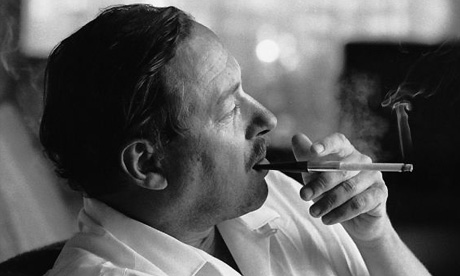
There is a time for departure even when there's no certain place to go.
So--I'm sitting here and getting nowhere. I save a very expensive chocolate bar and a glass of Pellegrino and a read-every-year novel (Laurie Colwin's Happy All the Time, as she is the 20th-century thinking American's Jane Austen, without the simpering and with better descriptions of pastries and marzipan roses), for this evening. I fall asleep and then awaken crying. I am curved like a fetus or a crescent moon or a croissant from a very expensive bakery around the exact shape that would have been your body. I flip over and no one turns with me in the hammock-like balance that allows us to sleep in a full-sized bed (two adults in a small space that no one else could understand we shared), and no hand's lying along the lyre of my ribcage, or slipping down to burnish my hipbone.
Life is all memory, except for the one present moment that goes by you so quickly you hardly catch it going.
I absolutely hate this insomnia. I absolutely hate not being married. I absolutely hate that you're not here. I said it and I meant it when I swore to it, but does death have to part us with such a dull blade? It leaves splinters of bone and arterial blood and keloid lumps in the mattress. Can't it just sever this not-quite-umbilical cord, this diver's airline?
Time rushes towards us with its hospital tray of infinitely varied narcotics, even while it is preparing us for its inevitably fatal operation.
And why do I try to read a novel that celebrates marriage and beginnings and domesticity and family life? Why don't I pick something slightly more cheerful, such as Smith's Recognizable Patterns of Human Malformation, which is probably upstairs with your collection of 15 out-of-date globes, worlds that don't exist any more, countries whose outlines have shifted--continental drift and tectonic plates rasping against each other in the too-crowded cupboard of underground?
The violets in the mountains have broken the rocks.
It is not enough to live for our children, although I love our children. It is not enough to think of other people, as I am basically a selfish oldest child and every once in a while I would like someone to think of me, of what I wanted, which was for you NOT TO DIE. It is not enough to know that I have done the right thing, when no one else cares what it cost me. For everyone else, it is all about closure, and I have the screen door that won't stay shut and bangs again and again and again against its rotting jamb as the summer wind slaps it open and closed, open and closed. Nothing's closed; nothing's open-and-shut; nothing's cauterized. It's a heart's beat, that thud. It's dread, knowing that sound is coming again, again.
A vacuum is a hell of a lot better than some of the stuff that nature replaces it with.
Do you know what it was like for me to stand in the exact spot where you and I first kissed, or where you dropped on one knee to ask me to marry you, where you carried me over every threshold? Do you have any idea what it was like to have well-meaning people tell me that you'd want to be in the middle of a pasture because that was the place you loved best and not to scream, No, it wasn't--I was the place you loved best?
Hell is yourself.
Do you know that the person who cried for me and held me, who offered comfort for me, was a complete stranger--a young girl who told me Take as long as you want, and come back whenever you need? Do you know how beatific those words were for me? Do you know that she didn't think I was crazed, although I am crazed like the world's most damaged china, repaired with staples and metal welding?
I have always depended on the kindness of strangers.
Do you know what it is like for the first time in two dozen years not to spend New Year's Eve with only you? Do you know what it's like to make a resolution not to die this particular day, although every breath I take is a gasp for air in a fire-flooded house, and my blood feels thick and cherry-pink as pie filling from carbon monoxide? Something is missing--do you know that all the air has been sucked out of every room? Do you know what it is like to miss you at a molecular level? O2 becomes O. Valences and co-valences are broken.
We all live in a house on fire, no fire department to call; no way out, just the upstairs window to look out of while the fire burns the house down with us trapped, locked in it.
Constellations are missing their brightest star. I am missing you. (The Latin for star is Stella! Does it do any good to call out to the stars, to make a wish?).
Stella! Stella!
I did not drop off or bring by your ashes or take you home, as the e-mails I have received suggest. I gave you back to the universe, who gave you to me. You aren't in Tennessee under a heart-shaped plinth of chert. You aren't in Kentucky in the Japanese rock garden. You aren't white ash on the rosebushes you moved three times for me. You are elsewhere. And I'm here, and I'm trying my best to sit here and pretend that I no longer have a heart.
We are all sentenced to solitary confinement inside our own skins, for life.
I'm glad you don't know this feeling. This feeling isn't new. This year's not new, either. It's five months, 17 days, and 10 hours. It's Holly and David Roby and Brandon and me all happy and drinking gin and tonic on the veranda at Sewanee. It's the vanilla-sugar cookie scent of you suddenly in my car as I drive back to my room to sit in the window seat and think how blue-silver-green the pine needles are, and how I'd like to have a room that same color. It's feeling as though I could write anything and be fearless, which were your last words to me in person. It's reading your last text message to me, the one I read again only seconds before the Sewanee staff came to me and held me and told me that you were gone: Today's mush: Oatmeal, applesauce. My brain, thinking of you.
Time is the longest distance between two places.
I'm thinking again of Williams, whose estate founded Sewanee, where I was a Tennessee Williams Scholar, if only for a day. I was wearing my charm bracelet and leading a charmed life.
50% of charm is illusion.
And it's tragedy and fragility and beautiful words and Williams again and yet again.
Death is one moment, and life is so many of them.
Subscribe to:
Posts (Atom)