Friday, January 14, 2011

Six. Months. Today.


WHEN YOU GO AWAY--W.S. Merwin

When you go away the wind clicks around to the north
The painters work all day but at sundown the paint falls
Showing the black walls
The clock goes back to striking the same hour
That has no place in the years

And at night wrapped in the bed of ashes
In one breath I wake
It is the time when the beards of the dead get their growth
I remember that I am falling
That I am the reason
And that my words are the garment of what I shall never be
Like the tucked sleeve of a one-armed boy

____
SEPARATION--W.S. Merwin

Your absence has gone through me
Like thread through a needle.
Everything I do is stitched with its color.
_____
ELEGY--W.S. Merwin

Who would I show it to

Thursday, January 13, 2011

Whale Sound: "First Anniversary"


The divine Nic Sebastian reads one of my poems today. I'm so grateful to her! Click on the link above to listen. It's beautiful.

Wednesday, January 12, 2011

Harvey's Journal: January 12, 2010

What is all else to us? only that we enjoy each other,
and exhaust each other, if it must be so;)
From the master—the pilot I yield the vessel to,
The general commanding me, commanding all—from
him permission taking,
From time the programme hastening, (I have loitered
too long, as it is;)
From sex—
From the warp and from the woof,
(To talk to the perfect girl who understands me—the
girl of The States,
To waft to her these from my own lips—to effuse
them from my own body;)
From privacy—
From frequent repinings alone,
From plenty of persons near, and yet the right person
not near,
From the soft sliding of hands over me, and thrusting
of fingers through my hair and beard,
From the long-sustained kiss upon the mouth or
bosom,
From the close pressure that makes me or any man
drunk, fainting with excess,
From what the divine husband knows—from the
work of fatherhood,
From exultation, victory, and relief—from the bed-
fellow's embrace in the night,
From the act-poems of eyes, hands, hips, and bosoms,
From the cling of the trembling arm,
From the bending curve and the clinch,
From side by side, the pliant coverlid off throwing,
From the one so unwilling to have me leave—and
me just as unwilling to leave...

Walt Whitman has it right--beginning every line alike, what Pamela calls anaphora. I think we are still at the beginning of how much we will love each other. I remember she wrecked her car 23 years ago today, and that was the beginning of it; and then she kissed me good night on January 17, our first date, and that was the complication of it, when I wrecked my car thinking about that kiss; and some days even now we'll be in a car driving to the lake or to the library--somewhere--and I'll look over at that profile and think From that day, this one and I will know that we are blessed.

Monday, January 10, 2011

Carol Ann Duffy and Transformation


Warming Her Pearls--Carol Ann Duffy


Next to my own skin, her pearls. My mistress
bids me wear them, warm then, until evening
when I'll brush her hair. At six, I place them
round her cool, white throat. All day I think of her,

resting in the Yellow Room, contemplating silk
or taffeta, which gown tonight? She fans herself
whilst I work willingly, my slow heat entering
each pearl. Slack on my neck, her rope.

She's beautiful. I dream about her
in my attic bed; picture her dancing
with tall men, puzzled by my faint, persistent scent
beneath her French perfume, her milky stones.

I dust her shoulders with a rabbit's foot,
watch the soft blush seep through her skin
like an indolent sigh. In her looking-glass
my red lips part as though I want to speak.

Full moon. Her carriage brings her home. I see
her every movement in my head...Undressing,
taking off her jewels, her slim hand reaching
for the case, slipping naked into bed, the way

she always does...And I lie here awake,
knowing the pearls are cooling even now
in the room where my mistress sleeps. All night
I feel their absence and I burn.

Saturday, January 08, 2011


Life these days has turned me into an oyster.

I am caged by it, as in crinoline.

As in bathtub gin, bobby pin, christ within, conjoined twin, coq au vin, cotton gin, dorsal fin, flour bin, in like Flynn, Marilyn, mickey finn, mortal sin, motor inn, next of kin, on the chin, Rin-Tin-Tin, show some skin, verduin, violin, West Berlin.

Friday, January 07, 2011

Words of Power from qarrtsiluni

Go check this out--Harvey has two drawings, one of which is the cover image, and I have a poem inside. I love this issue and am so grateful to Beth and Dave for remembering and honoring Harvey in this way.

The issue is beautiful and well worth ordering.


We’re pleased to announce the publication of the print edition of our Words of Power issue, which appeared online in Fall 2009, with qarrtsiluni’s managing editors, Dave Bonta and Beth Adams, at the helm. This edition is dedicated to the memory of Harvey Parker, a contributor to the issue who died suddenly last summer. It was designed and published by Phoenicia Publishing in Montreal, has a full-color cover, 126 pages, and is available for $14.25 from the online store or from Amazon.

Words of Power is a magic box filled with curses and spells, charms and prayers, incantations, imprecations, castigations, oaths and legal instruments, mantras and scripture — and a collection of remarkable images inspired by the theme.

Be sure to visit our publishing partner’s new website, browse their catalogue and read their news blog. The listing for Words of Power urges customers to “Please consider ordering from our online store: almost twice as much of your purchase goes toward supporting the authors and independent publishing, and foreign shipping rates tend to be favorable. We’re happy to offer sales through Amazon for your convenience too.”

Anaphora and Amen


Saint Brigid's Prayer

I would like the angels of Heaven to be among us.
I would like an abundance of peace.
I would like full vessels of charity.
I would like rich treasures of mercy.
I would like cheerfulness to preside over all.
I would like Jesus to be present.
I would like the three Marys of illustrious renown to be with us.
I would like the friends of Heaven to be gathered around us from all parts.
I would like myself to be a rent payer to the Lord; that I should suffer distress, that he would bestow a good blessing upon me.
I would like a great lake of beer for the King of Kings.
I would like to be watching Heaven’s family drinking it through all eternity.

- Saint Brigid

Thursday, January 06, 2011

Brought to You by Four Wise Men: The Magi and a Fellow from Dublin (Old Double-J)


(The Adoration of the Magi, Giotto)

In discussions with his brother, James Joyce defined epiphanies as "little errors and gestures — mere straws in the wind — by which people betrayed the very things they were most careful to conceal." He also defined epiphany as the "revelation of the whatness of a thing," the moment when "the soul of the commonest object ... seems to us radiant." "Scrupulously mean" versus "illuminating the thing"--epiphany, like the month in which it falls, has two faces. Make it--no them--manifest.

Happy 12th Night!

Wednesday, January 05, 2011

Today's Poem--Going, Going....


FIRST PERSON PLURAL, FIRST PERSON SINGULAR

“A woman’s voice is naked.”-- Babylonian fragment

“A single line, at the bottom of the page, leaves too much space.”
Printer’s Handbook

I. Oui

I was never interested in falling, as you

*** Smoke and Mirrors!***

Tuesday, January 04, 2011

Brought to You by the Letters D and F


On this day in 1785, Jacob Grimm, one of the Brothers Grimm, was born. Their master work, Children's and Household Tales, later known as Grimm's Fairy Tales, was published in several volumes from 1812 to 1822, and all of the volumes quickly became best sellers. Grimm's Fairy Tales preserved these Marchen: "Cinderella," "Hansel and Gretel," "Little Red Riding Hood," "Rapunzel," "Rumpelstiltskin," "The Six Swans," "Sleeping Beauty," and "Snow White." Unlike many other fairy tale collections, which presented folklore as fables, poems, or Gothic tales, these Marchen were presented as stories. The Brothers Grimm documented the phrases and narrative styles of the storytellers who passed these tales down from generation to generation, preserving the imagery as accurately as possible. This transcription approach to the tale inaugurated a scientific approach to the study of oral history and folklore.

Three things strike me about Jacob's later work. First, he was interested in languages and their interrelationships, how they shifted over time. Grimm's Law documents a systematic sound shift in Indo-European languages and is influential in the study of modern linguistics. (I remember Grimm's Law from my own linguistics classes). Second, Jacob also wrote other books about monsters and German mythology. German Mythologies traces Teutonic myth back to its earliest origins. Finally, Jacob, along with his younger brother Wilhelm, began to assemble a gargantuan German dictionary, but Wilhelm died in 1859, in the throes of the letter D. F felled Jacob four years later.

What can I conclude from this musing?

1. Story should be preserved. Integral to story is the sound of the language--dialogue, imagery, narrative frame, narrative arc all depend on sound and silence.

2. Sounds change over time, so slight shifts in the storytelling voice may tell the reader something more about how time moves than she might initially think. How does a child's voice change from beginning to end, when he may be an adult? Does it change in the frame novel? How? (I've been re-reading True Grit, and thinking about Mattie's voice).

3. Mythology is vital to literature, and understanding motif means knowing mythology. The origin of the word, mythos is simply story. I have never had this subject addressed in a creative writing or forms class, and I've have never addressed it as an instructor except in a poetry class. (I have proposed genre seminars on the Marchen, but I've never been approved to teach one).

4. Oh, yeah, nonfiction can kill you.

And now my tale is done. See the mouse run.

Monday, January 03, 2011

"oh Prime Minister we love you get up"


Visit She Writes
Widget_logo

Lines in the Sand: Will & Glenn & Why Not


Shakespeare tells you why I won't stop writing, even though you've asked:

Give sorrow words: the grief that does not speak
Whispers the o'er-fraught heart, and bids it break.


Macbeth, Act IV, scene 3, lines 209-210

I come from a family (by birth and by marriage) who actually hushed Harvey and me and asked that we not make any noise when standing before the Bill of Rights, so I'm not surprised that you've asked me not to say how I feel. I also believe in the Bill of Writes: Write it so you right it.

Glenn Gould also tells you why I won't stop:

Cast away all that you were told
And the theory that you read.


Sunday, January 02, 2011

Gravity, the Chariot, the Well, the Name: Being Pulled


If I get there before you do,
(Coming for to carry me home)
I'll cut a hole and pull you through.
(Coming for to carry me home)

Variant verse of "Swing Low, Sweet Chariot"
_______


In a chariot, you ride alone. You drive straight ahead and, crab-like, fight from the side.

I'd like to be pulled into the sky through a hole-punch cloud, straight to wherever you are.

I wouldn't mind blitzkrieg, and I've already been blindsided.

Take me in.
______

Summer at Blue Creek, North Carolina

There was no water at my grandfather's
when I was a kid and would go for it
with two zinc buckets. Down the path,
past the cow by the foundation where
the fine people's house was before
they arranged to have it burned down.
To the neighbor's cool well. Would
come back with pails too heavy,
so my mouth pulled out of shape.
I see myself, but from the outside.
I keep trying to feel who I was,
and cannot. Hear clearly the sound
the bucket made hitting the sides
of the stone well going down,
but never the sound of me.

Jack Gilbert
_____

Proprioception, from the Latin proprius, meaning "one's own" and perceptio, "to take in," is a neurological term for sensory awareness, the ability to sense the relative position of neighboring parts of the body.


I have lost my sense of place--my proprietary interest in the universe. I have lost "one's own." Like the widow (which I am), I search everywhere for that valuable thing I lost--in books, in art, in music, in dreams.

I keep trying to feel who I was,/and cannot.

That describes my stroke, when I could tell my left arm to move, and the fingers wouldn't wave. This is worse. How can I love my neighbor as myself, when I can't feel myself? Who am I now that everything is over and I am perhaps no longer Mrs. Harvey Parker. (I'm the only person I know who liked being called Mrs. I liked taking Harvey's name. It was not the surname of my childhood or of my first marriage. I loved the sound of Pamela Parker, and now I hear it in the same way as Paul McCartney might have first heard Eleanor Rigby, who as you know died and was buried along with her name.)

A name is "one's own," and now I don't know mine. I can hardly take it in.


______

Saturday, January 01, 2011

A New Years Benediction from Neil Gaiman


Here's a transcript:

May your coming year be filled with magic and dreams and good madness. I hope you read some fine books and kiss someone who thinks you're wonderful. And don't forget to make some art -- write or draw or build or sing or live as only you can.

May your coming year be a wonderful thing in which you dream both dangerously and outrageously. I hope you'll make something that didn't exist before you made it, that you will be loved and you will be liked, and that you will have come to love and to like in return.

And most importantly, because I think there should be more kindness and more wisdom in the world right now, I hope that you will when you need to be, be wise, and that you will always be kind.

And I hope, that somewhere in the next year, you surprise yourself.

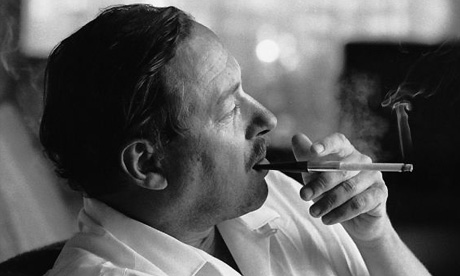
Dysmorphology: Remembering You Through Tennessee Williams


There is a time for departure even when there's no certain place to go.

So--I'm sitting here and getting nowhere. I save a very expensive chocolate bar and a glass of Pellegrino and a read-every-year novel (Laurie Colwin's Happy All the Time, as she is the 20th-century thinking American's Jane Austen, without the simpering and with better descriptions of pastries and marzipan roses), for this evening. I fall asleep and then awaken crying. I am curved like a fetus or a crescent moon or a croissant from a very expensive bakery around the exact shape that would have been your body. I flip over and no one turns with me in the hammock-like balance that allows us to sleep in a full-sized bed (two adults in a small space that no one else could understand we shared), and no hand's lying along the lyre of my ribcage, or slipping down to burnish my hipbone.

Life is all memory, except for the one present moment that goes by you so quickly you hardly catch it going.

I absolutely hate this insomnia. I absolutely hate not being married. I absolutely hate that you're not here. I said it and I meant it when I swore to it, but does death have to part us with such a dull blade? It leaves splinters of bone and arterial blood and keloid lumps in the mattress. Can't it just sever this not-quite-umbilical cord, this diver's airline?

Time rushes towards us with its hospital tray of infinitely varied narcotics, even while it is preparing us for its inevitably fatal operation.
And why do I try to read a novel that celebrates marriage and beginnings and domesticity and family life? Why don't I pick something slightly more cheerful, such as Smith's Recognizable Patterns of Human Malformation, which is probably upstairs with your collection of 15 out-of-date globes, worlds that don't exist any more, countries whose outlines have shifted--continental drift and tectonic plates rasping against each other in the too-crowded cupboard of underground?

The violets in the mountains have broken the rocks.

It is not enough to live for our children, although I love our children. It is not enough to think of other people, as I am basically a selfish oldest child and every once in a while I would like someone to think of me, of what I wanted, which was for you NOT TO DIE. It is not enough to know that I have done the right thing, when no one else cares what it cost me. For everyone else, it is all about closure, and I have the screen door that won't stay shut and bangs again and again and again against its rotting jamb as the summer wind slaps it open and closed, open and closed. Nothing's closed; nothing's open-and-shut; nothing's cauterized. It's a heart's beat, that thud. It's dread, knowing that sound is coming again, again.

A vacuum is a hell of a lot better than some of the stuff that nature replaces it with.

Do you know what it was like for me to stand in the exact spot where you and I first kissed, or where you dropped on one knee to ask me to marry you, where you carried me over every threshold? Do you have any idea what it was like to have well-meaning people tell me that you'd want to be in the middle of a pasture because that was the place you loved best and not to scream, No, it wasn't--I was the place you loved best?

Hell is yourself.

Do you know that the person who cried for me and held me, who offered comfort for me, was a complete stranger--a young girl who told me Take as long as you want, and come back whenever you need? Do you know how beatific those words were for me? Do you know that she didn't think I was crazed, although I am crazed like the world's most damaged china, repaired with staples and metal welding?

I have always depended on the kindness of strangers.

Do you know what it is like for the first time in two dozen years not to spend New Year's Eve with only you? Do you know what it's like to make a resolution not to die this particular day, although every breath I take is a gasp for air in a fire-flooded house, and my blood feels thick and cherry-pink as pie filling from carbon monoxide? Something is missing--do you know that all the air has been sucked out of every room? Do you know what it is like to miss you at a molecular level? O2 becomes O. Valences and co-valences are broken.

We all live in a house on fire, no fire department to call; no way out, just the upstairs window to look out of while the fire burns the house down with us trapped, locked in it.

Constellations are missing their brightest star. I am missing you. (The Latin for star is Stella! Does it do any good to call out to the stars, to make a wish?).

Stella! Stella!

I did not drop off or bring by your ashes or take you home, as the e-mails I have received suggest. I gave you back to the universe, who gave you to me. You aren't in Tennessee under a heart-shaped plinth of chert. You aren't in Kentucky in the Japanese rock garden. You aren't white ash on the rosebushes you moved three times for me. You are elsewhere. And I'm here, and I'm trying my best to sit here and pretend that I no longer have a heart.

We are all sentenced to solitary confinement inside our own skins, for life.

I'm glad you don't know this feeling. This feeling isn't new. This year's not new, either. It's five months, 17 days, and 10 hours. It's Holly and David Roby and Brandon and me all happy and drinking gin and tonic on the veranda at Sewanee. It's the vanilla-sugar cookie scent of you suddenly in my car as I drive back to my room to sit in the window seat and think how blue-silver-green the pine needles are, and how I'd like to have a room that same color. It's feeling as though I could write anything and be fearless, which were your last words to me in person. It's reading your last text message to me, the one I read again only seconds before the Sewanee staff came to me and held me and told me that you were gone: Today's mush: Oatmeal, applesauce. My brain, thinking of you.

Time is the longest distance between two places.

I'm thinking again of Williams, whose estate founded Sewanee, where I was a Tennessee Williams Scholar, if only for a day. I was wearing my charm bracelet and leading a charmed life.

50% of charm is illusion.

And it's tragedy and fragility and beautiful words and Williams again and yet again.

Death is one moment, and life is so many of them.